


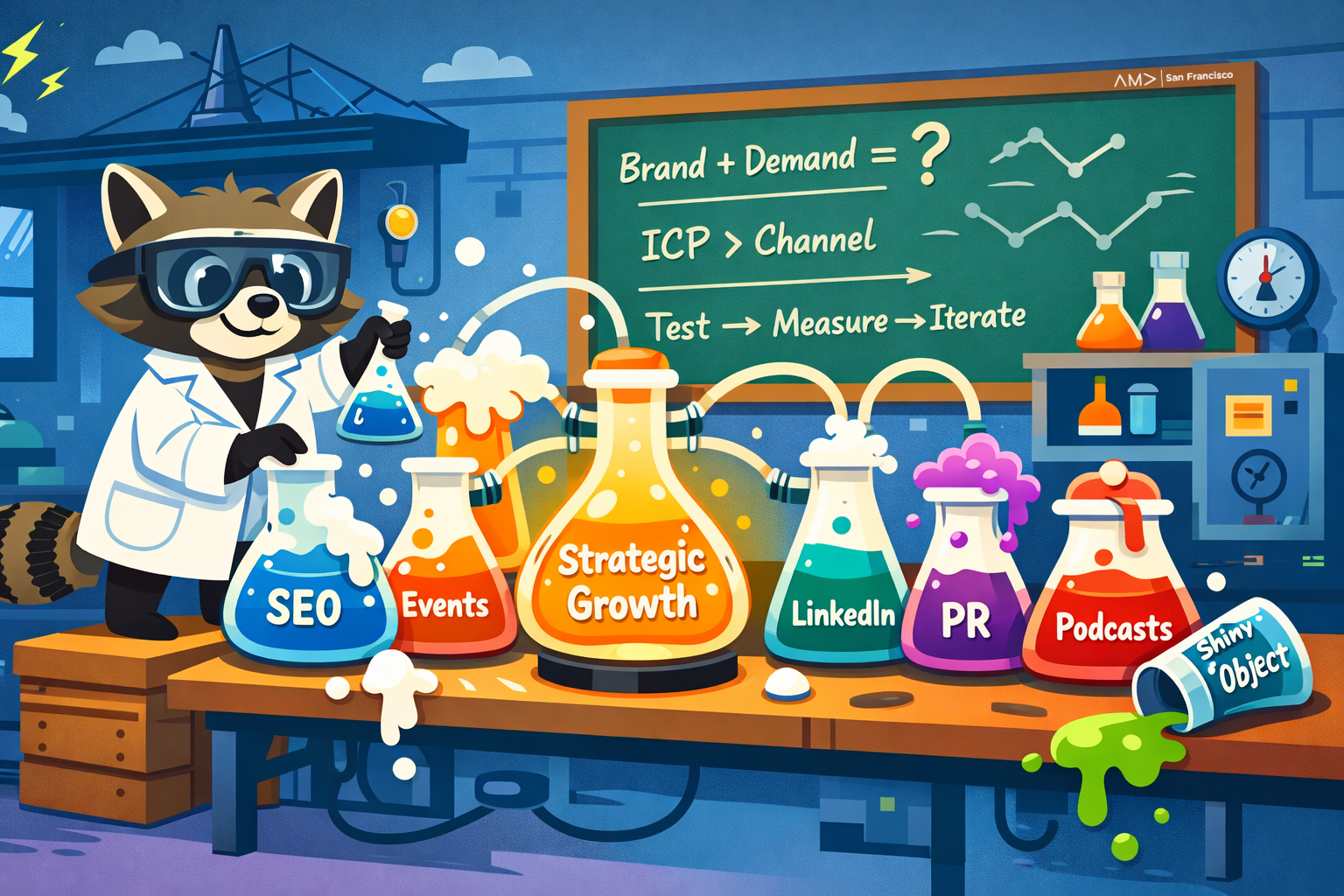
In our latest Misadventures in Marketing episode, Channel Surfing, Steve Haney and Peter Farago tackled a deceptively simple question: how do modern marketing teams figure out which channels actually work, especially when you are starting from a cold start? The short answer, as Steve put it, is that “there’s no easy way”. The longer answer is where the real leadership lessons live.
This recap distills the themes that stood out to me most, particularly for marketing leaders navigating strategic growth, brand and demand alignment, and the messy reality of building momentum with limited resources.
There Is No Universal Channel Formula
Early in the conversation, Peter framed the core tension clearly. Every company talks about the same channels: social, email, paid advertising, PR, events, SEO, SEM, content. On the surface, the playbook looks familiar. However, he quickly added that “what works will be different for sure”. That line captures a truth that many modern marketing teams resist. We inherit a menu of tactics, yet we still have to decide which combination actually drives results for our specific audience, category, and stage.
Steve reinforced this from his own experience moving between companies. Even when products appear similar on paper, the underlying buying dynamics shift. The ICP changes. The personas shift. The urgency changes. When that happens, the marketing mix changes as well. For marketing leadership, this means we cannot outsource thinking to industry trends. We must interrogate our own context first.
Do the Unscalable Work Before You Scale
One of the strongest threads in the episode centered on the early-stage “cold start” reality. When you are small, you do not have the luxury of blanketing every channel. Peter referenced the classic startup principle of doing things that do not scale at the beginning. In practice, that means showing up in places that feel manual and inefficient but build credibility.
Steve offered a vivid example from his own career: instead of investing in massive trade show booths, start with the “crappy little table” at a highly targeted industry event. Have real conversations. Press the flesh. Be visible. He also shared a lesson that many of us learn the hard way. When a company stops showing up at key industry events, “people don’t think we exist”. Digital presence alone does not always substitute for physical visibility. For modern marketing teams, this is a reminder that strategic growth often begins with concentrated trust-building, not programmatic scale.
Brand and Demand Work Best Together
A recurring theme throughout the discussion was the tension between brand and demand. Short-term pipeline pressure can push teams toward purely performance-driven tactics. Long-term authority requires sustained narrative and thought leadership.
Peter described an approach he likes on LinkedIn: using founder-led content and amplifying it through thought leadership ads. Instead of broadcasting from a company page alone, the strategy leverages personal credibility to spark engagement. He positioned this as sitting at the intersection of brand and demand.
That framing matters for modern marketing leadership. Brand and demand are not opposing forces. When executed well, founder perspective and strong points of view can create mental availability while still supporting measurable pipeline goals. The caveat, as both hosts implied, is that the content must be substantive. Opinionated, experience-backed insight cuts through noise far more effectively than trend commentary.
Distribution Is Harder Than It Looks
Another practical insight from the episode was the growing difficulty of distribution. Creating a high-quality asset does not guarantee that anyone will see it.
Peter described the current environment as “messy,” noting that organic reach alone may not be enough. Channels feel noisier. Ranking feels harder. Audiences fragment across formats. At the same time, Steve pointed out the addictive nature of vertical video and how platforms are reshaping attention. If prospects are consuming short-form content after hours, marketing leaders must at least consider whether and how to meet them there.
The lesson is not to chase every shiny object but to pair strong assets with intentional distribution. As Peter summarized, you need both the asset and the distribution engine behind it. For modern marketing teams, that often means combining organic and paid tactics, testing niche podcasts and newsletters before broad buys, and always driving back to owned channels where you control the relationship.
Test with Hypotheses, Not Hope
Toward the end of the discussion, Steve raised a practical budgeting framework: devote most resources to proven channels, invest some in optimizing established plays, and reserve a smaller slice for experimentation. That model reflects disciplined experimentation rather than random exploration.
Peter emphasized that testing should start with common sense. Understand your audience. Understand your buying committee. Clarify whether you are targeting practitioners, leaders, or both. Then design experiments that map to those realities. This approach aligns closely with how high-performing marketing leadership teams operate. They define directional metrics. They set a time horizon. They adjust based on signal rather than emotion.
They also remember that “it’s better to do something than do nothing”. Paralysis rarely produces pipeline.
Marketing in today’s environment is iterative by design. It rewards leaders who are willing to experiment, recalibrate, and show up consistently where their audience gathers. That may not be a tidy playbook. It is, however, an honest one. And for those of us building and leading modern marketing teams, that honesty is exactly what moves us forward.
🎧 Tune in now to Season 3, Episode 2: Channel Surfing.
👉 Listen to the podcast on Spotify and Apple Podcasts.
📚 Check out summaries from other episodes:
- More Than a Mic: Strategic Speaking That Drives Growth
- When Nobody Cares: The New Rules of PR and Attention
- The New Reality: Content Has Never Been Easier—Or Harder
Misadventures in Marketing is a weekly podcast by the AMA San Francisco chapter. Veteran Silicon Valley marketing execs Peter Farago and Steve Haney explore the messy, rewarding, and occasionally absurd world of high-tech marketing — especially in early-stage startups. Each episode covers real-world challenges, trends, and lessons from the front lines.



Comments are closed.