


,This is the third and final piece in the three-part series exploring the structural shifts behind that reset and unpacks what they signal for 2026.. In Part I, we examined how AI without strategic clarity creates overwhelm instead of advantage, and why teams must solve real bottlenecks before adopting more tools. In Part II, we explored how social evolved from a distribution channel into full revenue infrastructure, forcing marketing leaders to think like operators instead of media buyers.
If the first shift centered on production competence and the second on revenue competence, this final shift focuses on relational competence. Because once you improve production and tighten revenue systems, one question remains: how deeply are you embedded in your customer’s identity?
BookTok generated 370 billion views and influenced 59 million print book sales in 2024. alone. That growth did not come from targeting broad demographic categories. It came from shared identity and passion via communities.
What Micro-Communities Actually Are
Micro-communities are small, tightly-knit online groups, typically 100 to 10,000 members, centered around specific interests, lifestyles, or shared goals. Unlike mass audiences, they thrive on authentic conversations rather than broadcast messages. Interaction is primarily peer-to-peer, not brand-to-consumer. Members form shared identities around niche interests like vegan fitness, NFT art, or indie game development.
The results speak for themselves: nearly 70% of consumers say access to a community increases their loyalty to a brand. Micro-communities generate conversion rates 40 to 60% higher than demographic targeting. What traditional segmentation misses is simple: demographics describe who someone is on paper. Communities reveal what they genuinely care about and advocate for publicly.
What’s struck me most about micro-community marketing is how poorly most brands execute it. They create “Brand X Community” and wonder why no one shows up. The successful ones build around the shared interest, not the brand name
How Nike Run Club Does It Right
Nike’s approach to the Nike Run Club is a masterclass in micro-community marketing. They identify specific urban centers and drill down into neighborhoods, recruiting authentic local running enthusiasts as “Pacers” and “Coaches.” Nike also integrates digital tools like the NRC app with physical guided runs and training programs.
The result: Nike becomes a supportive fitness partner, not just an apparel company. They create intimate, hyper-local communities where trust is built through expertise and consistency.
Building a Micro-Community Strategy
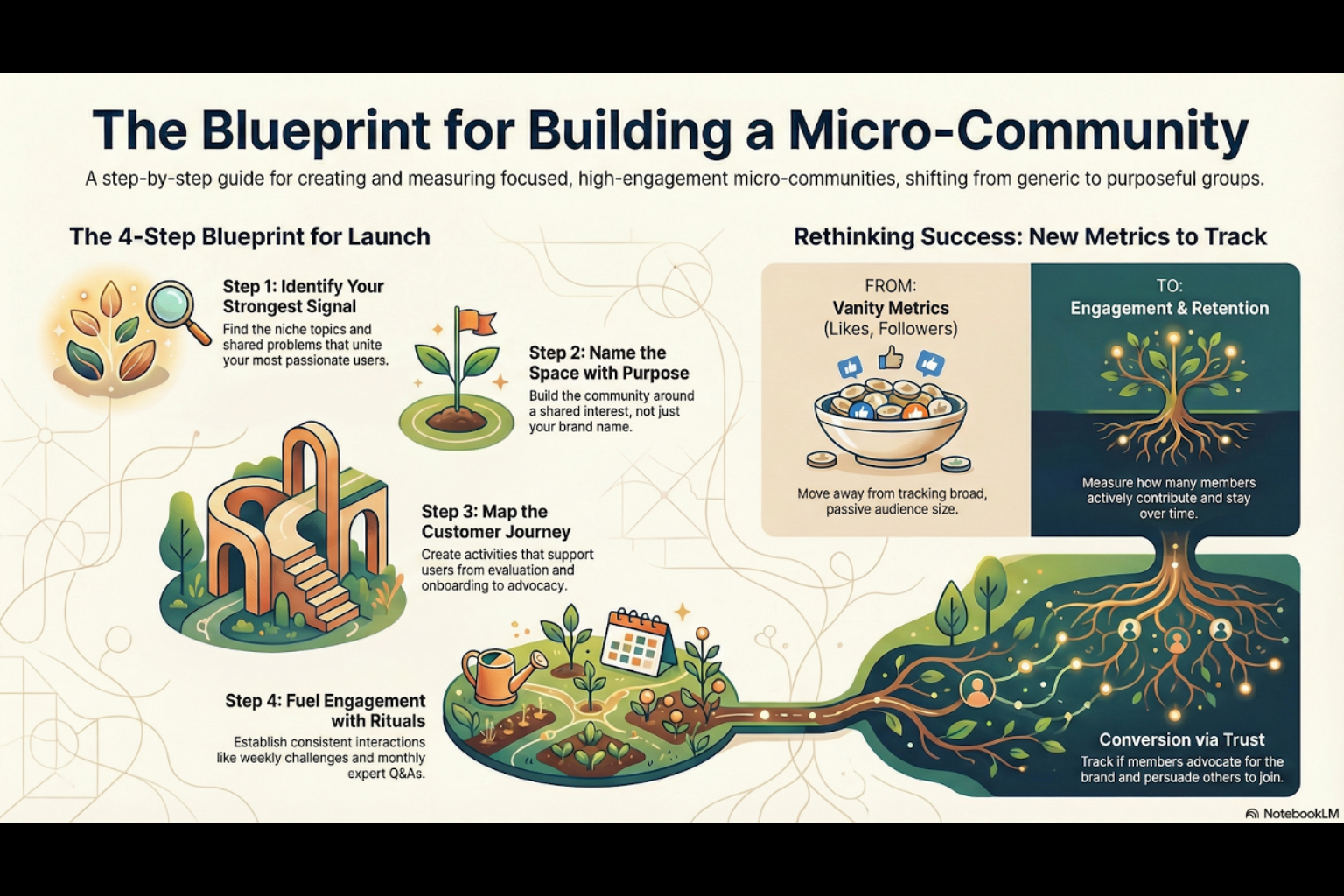
If you want to build your own micro-community, start with a clear operating structure.
1. Identify Your Strongest Signal
Start with your power users, champions, or a persona you want to serve better. What niche topics unite your most passionate customers? Where are they already gathering (Reddit, Discord, Facebook groups)? What shared problems or aspirations connect them?
2. Name the Space Around Purpose, Not Brand
Don’t create “The Brand X Community.” Build around the shared interest. Examples: “Product Experimentation Guild,” “Sustainable Fashion Advocates,” “Remote Work Parents Network.” You’re curating, not collecting.
3. Map the Customer Journey
Create spaces that accelerate movement through each stage. During evaluation, host live Q&As with product experts. For onboarding, provide week-by-week checklists with peer support. In adoption, run monthly clinics to unlock advanced features. For advocacy, offer sneak peeks and co-marketing opportunities.
4. Fuel with Rituals
Micro-communities die without consistent interaction. Build rituals like weekly challenges (“Show your dashboard,” “Share a workflow”), monthly expert AMAs, recognition programs that spotlight member contributions, and compilation highlights featured in blogs or webinars.
Measure What Actually Matters
Stop tracking likes, impressions, and follower counts. For micro-communities, measure engagement depth, are participants actively contributing, not just watching? Track retention over time. Do members stay active? Measure conversion via trust. Do members advocate for the brand or persuade others to join?
Demographics tell you who someone is. Communities tell you what they care about. That’s where conversion happens.
In closing: The Marketing Operating System for 2026
AI lowered the cost of execution across the marketing stack. Social platforms compressed the distance between influence and transaction. Micro-communities deepened identity and long-term loyalty. Together, these forces changed how sustainable growth actually happens.
While relatability can be manufactured quickly through surface-level tactics, competence must be earned through consistent execution and visible expertise. In 2026, advantage will not go to the loudest brand or the fastest experimenter. Advantage will belong to leaders who design systems that align technology with explicit strategic outcomes, treat distribution as infrastructure rather than theater, and embed expertise inside communities that reinforce identity over time. That is the essence of the competence era, and it rewards disciplined operators far more than performative marketers.
Marketing is evolving fast—and none of us should have to figure it out alone. At the American Marketing Association, you’ll find marketers sharing real experiences, hard-earned lessons, and practical frameworks for navigating change with clarity and purpose. If that sounds like your kind of community, we’d love to have you! Become a member today.
Comments are closed.