


Marketing did not simply evolve in 2025; it genuinely reset itself. For more than a decade, growth ran on reach, relatability, and rapid experimentation at scale. That approach still works in pockets, but it no longer guarantees durable advantage. AI leveled production capabilities across teams. Distribution became cheaper and more accessible. Audiences became sharper, more skeptical, and far less patient.
What actually cut through the noise this year was operational competence. Brands had to demonstrate real competence in how they used AI systems. They had to show discipline in turning social channels into revenue infrastructure. They had to build communities around identity and shared purpose instead of surface-level demographics.
This three-part series explores the structural shifts behind that reset and unpacks what they signal for 2026.
92% of Marketers Use AI. More Than Half Are Overwhelmed
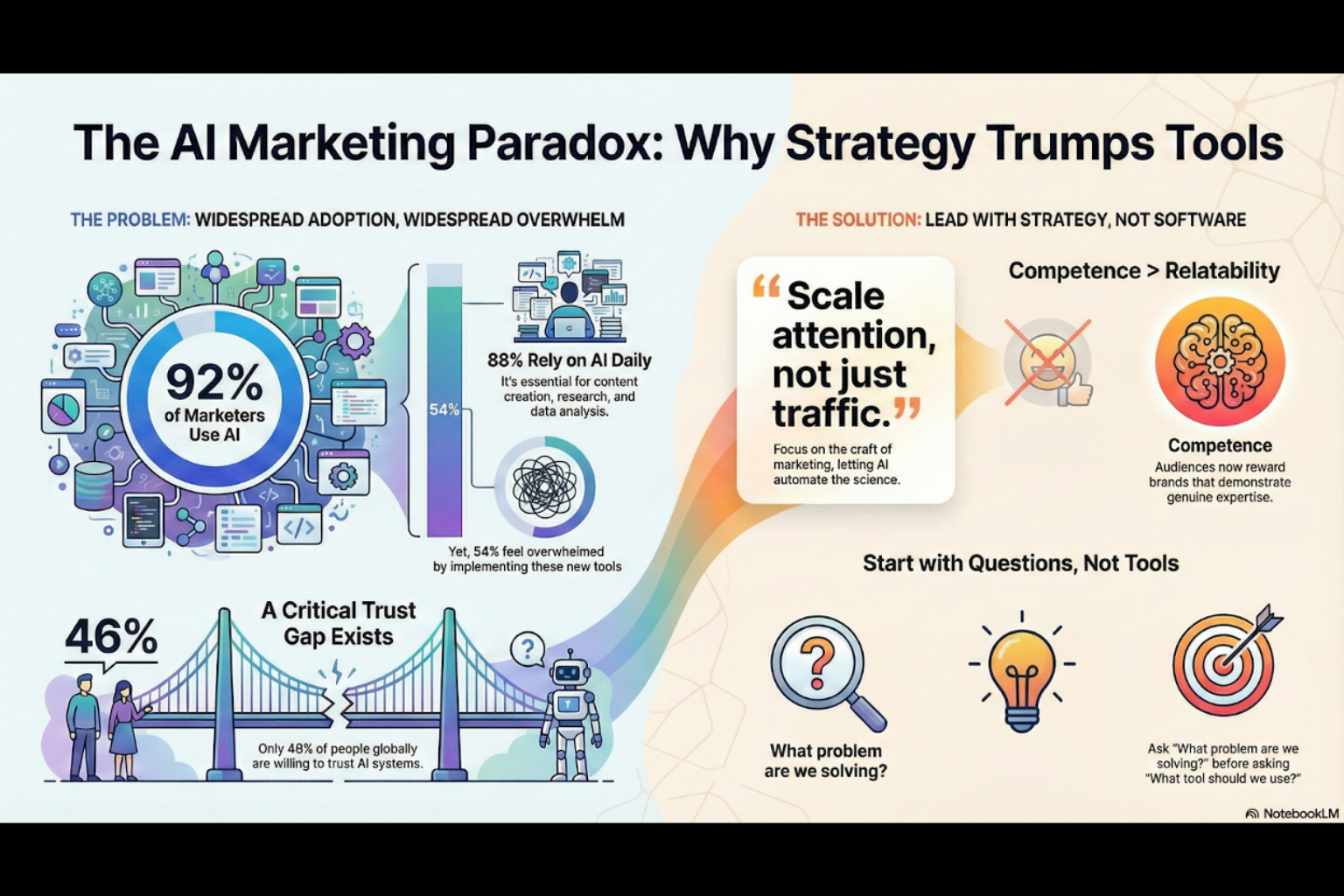
Ninety-two percent of marketers say AI has already impacted their roles. At the same time, 54% feel overwhelmed by implementing AI tools into their workflows. That tension is not about the technology itself. It is about teams adopting tools before defining what success should actually look like.
Adoption Outpaced Strategy
AI moved from experimental curiosity to operational necessity faster than most teams could realistically absorb. Nearly 88% of marketers now rely on AI daily for content creation, research, analysis, brainstorming, and skill development. One in four plan to use AI to transform text into multi-modal campaigns that extend across video, audio, and social formats. Close to half of both B2B and B2C marketers already see AI-influenced search behavior driving incremental traffic.
But here’s where it gets interesting: only 46% of people globally are willing to trust AI systems. This trust gap is creating what many are calling “AI fatigue” across the industry. Teams are drowning in tools without strategic clarity. What’s surprised me most isn’t that marketers feel overwhelmed, it’s that we’re still treating AI adoption like a checklist rather than a capability question. We’re asking “what tool should we use?” before asking “what problem are we solving?”
HubSpot SVP of Marketing Kieran Flanagan put it well when he said marketers must “scale attention, not just traffic.” AI will increasingly automate the science of marketing execution. Strong leaders will reinvest that leverage into sharper positioning, clearer prioritization, and stronger creative craft.
What Strategic AI Use Actually Looks Like
The brands winning right now are not using AI to flood channels with more content. They are using it to demonstrate deeper expertise and clearer judgment.
Nike’s “So Win” campaign marked its return to the Super Bowl after years of performance-heavy focus. Human creative direction anchored the storytelling while AI accelerated production workflows behind the scenes. The campaign secured the Super Clio Award and reasserted Nike’s authority in culture.
Chili’s opened a fake payday lender next to a Manhattan McDonald’s with their “Fast Food Financing” stunt, playfully addressing inflation concerns while launching their Big QP burger. The guerrilla activation drew three-hour lines and generated over 6 billion impressions, proving that competence means understanding your audience’s real problems and addressing them with boldness and humor.
Ramp, the $32B spend-management platform, noticed spa spending had dropped by 20%. Instead of publishing a static report, the company sent its in-house economist to a Russian bathhouse and documented the experience on LinkedIn. The team transformed raw data into narrative and turned insight into shareable entertainment.
Across each example, AI amplified competence rather than substituting for it.
The Takeaway: Start with Questions, Not Tools
Before adopting another AI platform, you should pause and answer these grounding questions:
- What specific workflow bottleneck are we trying to solve?
- How will we measure success beyond “faster output”?
- What human expertise must remain in the loop?
- How does this build trust with our audience?
When everyone has access to the same execution capabilities, success depends on using category expertise to produce better, not just more.
Action Checklist:
- Audit workflows to identify where AI truly enhances, not just accelerates work.
- Pilot AI tools in controlled campaigns with clear KPIs before full rollout.
- Invest in team training to build AI fluency alongside creative skills.
- Implement a “human-AI hybrid” content review process that maintains authenticity.
- Track consumer sentiment toward your AI-enhanced content, not just performance metrics.
When everyone has the same execution tools, expertise is the differentiator.
Stay tuned for Part 2 in this series!
Marketing is evolving fast—and none of us should have to figure it out alone. At the American Marketing Association, you’ll find marketers sharing real experiences, hard-earned lessons, and practical frameworks for navigating change with clarity and purpose. If that sounds like your kind of community, we’d love to have you! Become a member today.



Comments are closed.