


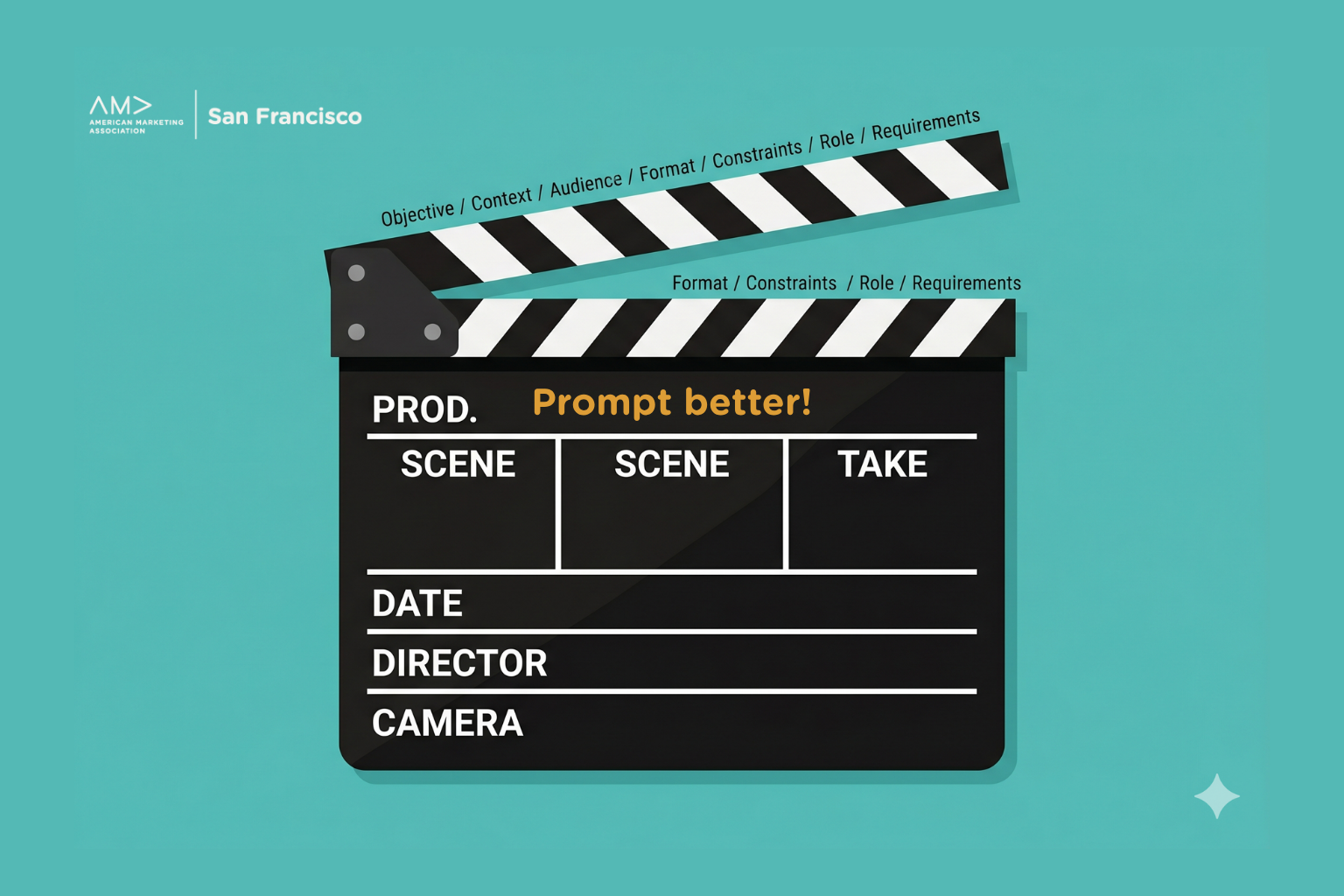
The marketers who get the most out of AI aren’t the ones using the most sophisticated tools. They’re the ones who know how to give a precise brief. Most teams adopted AI and immediately started using it like a search engine — type something vague, get something generic, call it done. The gap between that workflow and one that consistently produces on-brand, strategically sound content isn’t technical skill. It’s a framework. Gerardo Garcia-Jurado, author of Effective Marketing Decoded, has spent years teaching small business owners and marketing professionals exactly how to close that gap.
The Prompt Is the Strategy
AI doesn’t know your brand. It doesn’t know your audience, your tone, your competitive positioning, or what you actually need the content to accomplish. A vague prompt gets you generic output — and that generic output often costs more time to fix than writing from scratch would have taken. Gerardo addresses this directly in Effective Marketing Decoded: getting real results from AI requires treating it less like a magic button and more like a skilled collaborator that needs a proper brief before it can do its best work.
His seven-part prompting framework gives marketers a consistent structure for writing prompts that actually deliver. Each element in the framework addresses a specific failure mode that shows up when marketers skip it. Defining your objective removes ambiguity about what the content needs to accomplish. Providing context tells the AI what it’s working with — your brand voice, your product category, your competitive position. Specifying the target audience ensures the language and tone match the actual people you’re trying to reach, not some statistical composite.
The Elements Most Marketers Skip
Content requirements tell the AI what to include and what to prioritize. Format and style guide the actual shape of the output — length, structure, register, level of formality. Constraints specify what to avoid, which matters enormously for maintaining brand consistency and keeping outputs clean of filler phrases or off-tone language.
The element that tends to produce the biggest single improvement is role definition. Gerardo recommends instructing the AI to adopt a specific professional persona and to actively engage before drafting: “Act as a social media strategist… Ask me as many questions as you need until you feel you have all the information you need to generate the best posts.” That single instruction changes the entire dynamic. Rather than receiving a generic draft, you get a collaborator that probes for specifics, surfaces assumptions, and produces work already shaped around your actual needs.
Most marketers skip role definition entirely. Their outputs reflect that omission — content that’s technically competent but carries no personality, no brand voice, and no strategic intent. Asking AI to function as a passive generator instead of an active collaborator is precisely how teams end up spending more time editing AI copy than it would have taken to write it themselves.
Why Structured Prompting Separates the Field
The majority of marketers using AI tools report saving time — but time saved doesn’t automatically translate into quality improved. The teams pulling ahead are the ones applying structured prompting to ensure AI produces work that’s usable without three revision cycles. Unstructured prompting creates a hidden time tax: every edit you make to fix a vague AI output is time a structured brief would have saved upfront.
This is especially consequential for smaller marketing teams, where each person is responsible for multiple channels, multiple formats, and multiple audiences simultaneously. Gerardo’s book was written for exactly those environments — small businesses and aspiring professionals who don’t have the luxury of dedicated AI teams or unlimited revision time. The framework scales from a one-person operation to a full marketing department. Whether you’re drafting social posts, building email sequences, or briefing creative concepts, the same seven-part structure produces stronger inputs and, consistently, better outputs.
There’s also a brand coherence dimension that often gets overlooked. When multiple team members are prompting AI independently without a shared framework, the content that comes out sounds like it was written by several different companies. A structured prompting standard doesn’t just improve individual outputs — it aligns a team’s AI-generated content around a consistent voice.
Turning the Framework Into a Daily Practice
The fastest way to operationalize the seven-part framework is to write one prompt template per content type your team produces — social posts, email subject lines, blog briefs, ad headlines — and require everyone to start from those templates. The seven elements become the slots you fill in. Your objective, context, audience, requirements, format, constraints, and role definition get specified once for each format and reused across the team. After a few weeks, the templates evolve based on what actually produced usable output and what didn’t, and the standard becomes lived practice rather than documentation that sits unused.
A second shift worth making is treating prompts as artifacts worth saving and refining. The strongest prompts on a marketing team should be reviewed and improved the same way creative briefs or campaign plans are — version-controlled, shared in a central library, walked through with new hires during onboarding. Most teams treat prompts as disposable, which means every person is reinventing the brief from scratch each time they open a chat window. That’s the largest hidden source of inconsistency in AI-assisted marketing work.
Knowing how to write a precise AI brief has become a core marketing competency. The field has moved past debating whether AI belongs in the workflow. The real question now is whether your prompts are specific enough to produce something worth publishing — and if the answer isn’t a confident yes, the seven-part framework is the right place to start.
Marketing is evolving fast—and none of us should have to figure it out alone. At the American Marketing Association, you’ll find marketers sharing real experiences, hard-earned lessons, and practical frameworks for navigating change with clarity and purpose. If that sounds like your kind of community, we’d love to have you! Become a member today.




Comments are closed.