


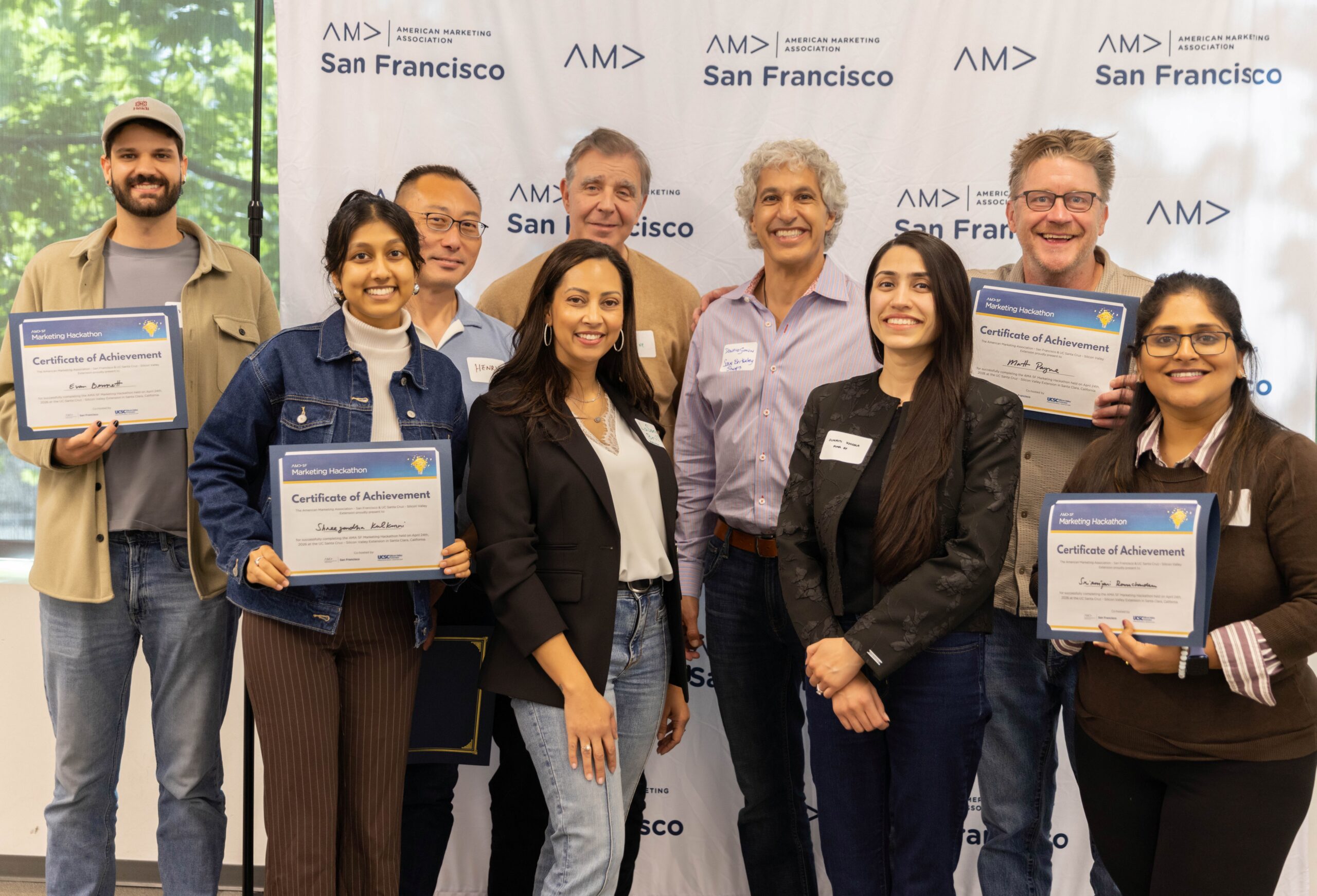
Most marketing teams scope a campaign over weeks, with rounds of executive feedback and ample time to second-guess every choice. The AMA San Francisco Marketing Hackathon strips all of that out and drops you into a three-hour sprint for a Bay Area nonprofit. You team up with people you have never worked with before, you have no paid media budget, and the only thing standing between strategy and submission is the clock. What comes out the other side, as this year’s winning team learned, is often sharper for the squeeze.
We sat down with Shreegandha Kulkarni and Sriranjani Ramachandran, two members of the 2026 winning team. The full crew of five also included Evan Bennett, Matt Payne and Henry Fan . They had to build a marketing plan for the nonprofit Save Berkeley Shops. Founded by Donald Simon, Save Berkeley Shops protects locally-owned small businesses from city-driven displacement. In three hours the team shipped a campaign poster, a website, and a full presentation with video, then walked away with first place.
The Winning Team, in Their Own Words
What inspired your team’s solution?
We built our plan with residents and shop owners at the center—not the city’s priorities. Rather than locking into one initial solution, we explored multiple directions. We were continuously iterating and improvising.
Early on, we mapped the Berkeley community’s actual demographics, then worked backward: If we need to reach these people, where do they spend their time? We analyzed what was already working in those channels, then designed our approach around that foundation.
How did your team organize itself once the clock started?
We started by mapping our individual strengths and skill sets, and avoided imposing structure – keeping things more open. Everyone contributed to the conversation: we debated, built on ideas, and landed on some positions while agreeing to disagree on others. After twenty to thirty minutes of deliberation, we divided the work. When someone needed help outside their assigned area, we pitched in without hesitation.
Tools became essential to that fluidity. We captured our live brainstorm in a Google Doc, using AI to transcribe our thinking as we talked through ideas. Then we structured everything collaboratively, ensuring every person understood every slide—not just their own section. That meant any one of us could have presented the entire deck solo.
The payoff came in the Q&A. When judges asked questions, we didn’t default to a single answerer. Two or three of us responded to each question, because we genuinely shared the same foundation. We weren’t coordinating on the fly, we were just all on the same page.
What was different about designing a campaign for a nonprofit versus a commercial brand?
The budget. They were very clear from the start that we should assume there is no paid media budget. If there had been one, we could have explored channels beyond organic marketing.
But the constraint didn’t change how we approached the brand itself. Our core thinking, our genuine investment in the community’s story—those were independent of budget. With paid media, we could have accelerated reach and polished the execution. The strategy underneath, though, would have remained identical.
How did the time pressure shape your creativity and decision-making?
Time absolutely constrained the design. We invested heavily in the ideation phase—bouncing concepts, testing directions—and that rigor paid off. But we built the actual deck too late. If we’d started structuring slides fifteen to twenty minutes earlier, AI could have helped us tighten the design and refine the messaging. We had so much to convey and so many ideas to explore, we had to constantly prioritize.
But on the flip side, the deadline was actually invaluable. With five people and that many competing ideas, unlimited time would have meant endless refinement, not better work. As marketers, the more time you give us, the better we will think the work can be — but the deadline is what forces a clean answer.
What surprised you most about this experience?
The pace was unprecedented for us. We’ve worked at fast-paced startups, but never compressed this much into this short a window. The AI tooling accelerated everything—not just the output, but our actual thinking process.
This was our first nonprofit project, and the subject matter was entirely new territory. We had to absorb the concept quickly, spend time with the domain expert, and translate that into concrete tactics—all within hours. We didn’t expect to pull that off.
What surprised us most, though, wasn’t the speed. It was the team dynamic. It’s rare to land on a team where everyone genuinely listens, builds on each other’s ideas, and stays proactive. Even if we hadn’t won, we’d be proud of this work—and we know we’ll use it and build on it later. That kind of collaboration only happens when nobody brings their ego into the room.
The Takeaway
The 2026 AMA SF Marketing Hackathon winning team won because of how they spent the first 30 minutes. Trust came first, then a wide-open round of brainstorming, then commitment to a single audience-first strategy before anyone touched a deck. AI tools handled the implementation, but the parts of the work that actually mattered came from the people in the room: the audience read, the strategic call, and the story arc.
That is the hard part to replicate. A small group of strangers, given three hours and a real cause, can produce work that holds up the test of reality. Tools can accelerate output, but they do not substitute for the chemistry that lets a five-person team move like one.
Once a year, the AMA San Francisco Marketing Hackathon brings marketers into a single room to build real deliverables for Bay Area nonprofits in one working day. It remains the only event of its kind in the AMA chapter network. To be the first to know when we do more such events, sign up for the AMA SF newsletter. In the meantime, learn more about Save Berkeley Shops and the impact this year’s winning team added to.
Marketing is evolving fast—and none of us should have to figure it out alone. At the American Marketing Association, you’ll find marketers sharing real experiences, hard-earned lessons, and practical frameworks for navigating change with clarity and purpose. If that sounds like your kind of community, we’d love to have you! Become a member today.

Comments are closed.