


On Season 3, Episode 5, Pitch, Please! of our Misadventures in Marketing podcast, co-hosts Steve Haney and Peter Farago talked at length about pitch decks. Both have spent years building them for startups, and both kept landing on the same fix: the deck is a footnote, and the speaker is the document. Pitch deck storytelling is the part most marketing teams skip, and it is the part that decides whether the room actually moves.
The pattern shows up across investor pitches, sales decks, and the brand-platform decks early-stage founders ask their marketing leads to throw together in a week. Everyone knows the cosmetic rules by now: a reasonable upper bound on slide count, a font size big enough to read from the back of the room, bullet points that are actually bullet points instead of paragraphs in disguise. None of that is the hard part of building a deck. The hard part is whether the deck has a spine at all.
What pitch deck storytelling actually means
Pitch deck storytelling is the practice of designing a presentation around a narrative arc rather than a slide stack. Each slide does one job in service of a larger argument. The titles, read alone, carry the storyline. Slide bodies are reference material the speaker fills in live. Audiences watch a person move through a sequence, not a screen full of text.
Steve is direct about the underlying mistake. “It’s not a word document, it’s not a word processing document, it’s a deck. And so what you have on the deck should just be an aid to the speaker and what they’re pitching.” That definition matters because two failure modes show up on most Bay Area pitch decks the speakers see. One is the document trap, where the slide becomes a word-processing surface, paragraphs spill into bullet points, and the speaker is reduced to reading their own page back to the room. The other is the decoration trap, where the slides are beautiful, the brand colors are tight, and nothing about the title sequence would tell a stranger what the argument actually is. Storytelling solves both modes, because both come from the same missing piece: there is no narrative spine carrying the slides through to a conclusion.
How Bay Area marketers structure a deck as a narrative
Peter described a discipline on the podcast that operationalizes the spine. “Most of my slide titles, I never have a slide title that wraps. It’s usually five to eight words max. Usually the slide title tells the point I wanted to tell.” When the deck is finished, he flips through it and rereads the titles to check that they progress in telling a story. If the titles alone do not carry the argument, the deck is not done.
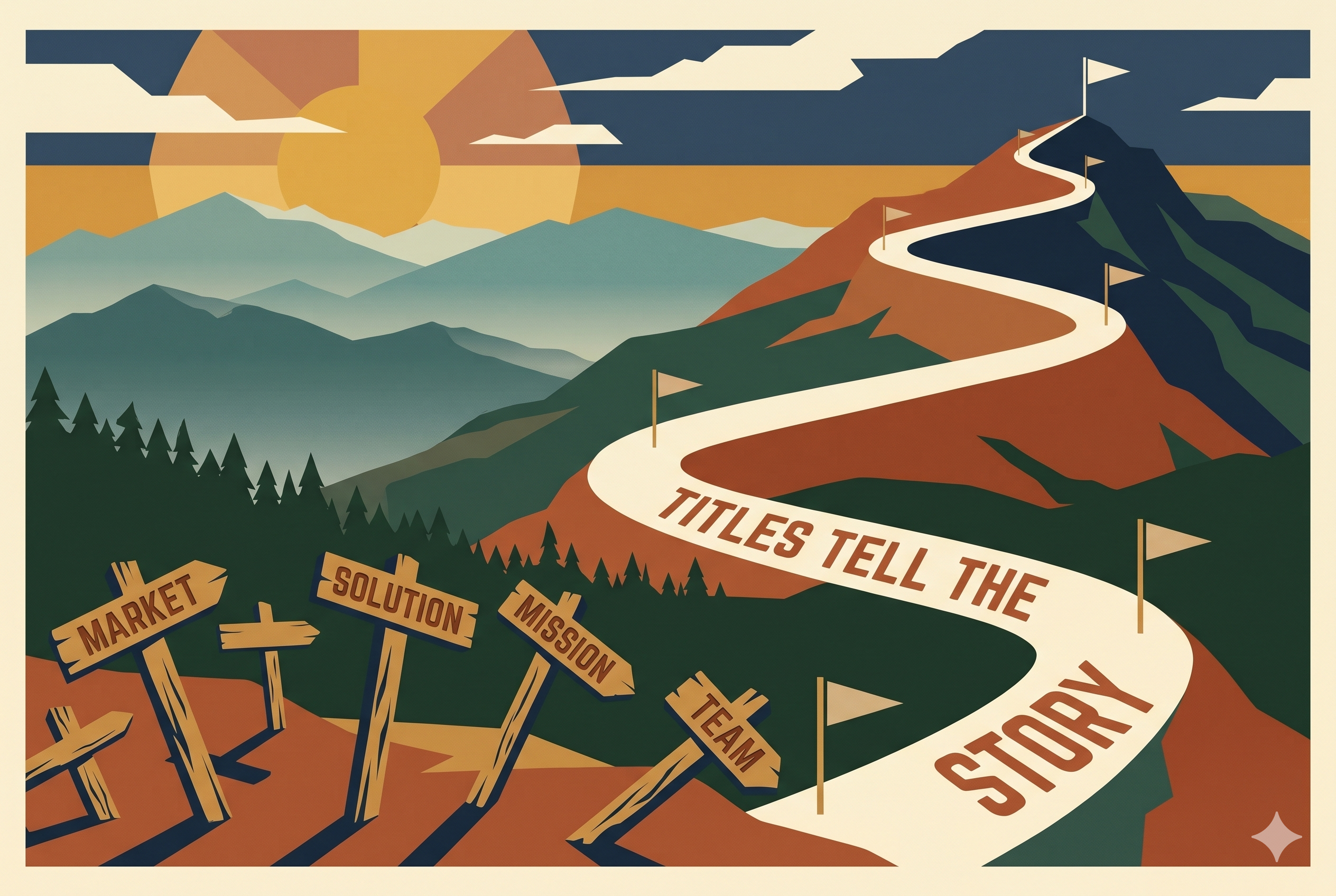
Try that test on the last deck you sent. Open it, hide the slide bodies, and read just the titles in order. If you cannot reconstruct the argument from the titles alone, the audience will not be able to either. Beautiful charts will not save a deck where slide three says “Market” and slide four says “Solution” and the connective logic lives only in the speaker’s head. What that produces is not a deck at all. The result is more like a slide jukebox.
Peter also reads the deck at different levels. “The titles progress in telling a story. So I reread titles at the end and I flip through it and I’m reading it at different levels.” That is the discipline behind a deck that works: title, visual, and narration each carrying their share of the load, none of them contradicting the others. A deck that survives the title test still has to survive being read at multiple levels at once. Read it aloud the way the audience will receive it, and watch whether the three channels point at the same conclusion.
Steve framed the same idea from the production side. A ten-slide brand-positioning deck for a founder team is a narrative about who the company is. Sales decks tell a different story — about the customer’s problem and how the product changes their day. That logic extends to any persuasion document a marketing team owns. The deck is always built to move someone to take an action. If the slides do not visibly move toward that action, the action will not happen.
Headlines, visuals, and data each do work on a slide. One of those three carries the load on any given page, while the speaker carries the connective tissue between them. A slide is not a paragraph with decoration on it. It is closer to a billboard, with a single headline, a single visual, and a single piece of evidence, sequenced inside a narrative that the speaker is delivering live.
The speaker, not the slide, is the center of attention
Steve delivered the hardest sentence of the conversation about who the audience is really watching. “The majority of people don’t want to be the center of attention, but the whole point is that you are.” Audiences do not absorb the deck. They absorb the person standing in front of it. Visual scaffolding is the deck’s only job, and that job is keeping the speaker on track.
That reframe has a practical move attached to it, and it is one of the more underused features in current presentation software. Drop a webcam window onto the slide itself, usually in the lower-right corner, so the audience watches the speaker’s face on the same surface as the slide content. The video does what the slide alone cannot do. It pulls the audience back to the person delivering the argument and stops the slide from competing for attention. For async pitches and video-first sales motions, the webcam overlay is closer to a requirement than a nice-to-have.
There is a separate case worth naming, because Steve flagged it directly. Investor decks that get emailed without a presenter have to read on their own. A title that says “Mission” with a single graphic underneath will not survive solo. Those decks need more text because the human carrying the narrative is not in the room. Build the same skeleton, then add the connective copy the speaker would have said. Do not confuse the read-alone deck with the live-delivery deck, and never use the same file for both jobs. The decoration trap usually starts with that confusion.
The deeper point is the one the chapter has made elsewhere about brand work. AI can polish your brand, but only you can build its story. The same logic applies one layer down at the deck level. A polished deck without a narrator is a brochure. Add a narrator who knows the through-line, and the same deck becomes a persuasion engine. Every other discipline that lives at the intersection of design and storytelling has figured this out, including the new era of sports storytelling where the broadcast is built around the athlete, not around the highlight reel.
The next time a CEO hands you a slide deck assignment, do the title test before you open a single template. Write the ten titles first and read them in sequence. If they make an argument all by themselves, build the rest of the deck around them. Without that argument, you have not actually started yet. The slide stack can wait until tomorrow. Story is the part that cannot wait at all.
 Tune in now to Season 3, Episode 5: Pitch, Please!
 Listen to the podcast on Spotify and Apple Podcasts.
 Check out summaries from other episodes:
- The New AI-Powered B2B Customer Journey
- Resilience, Discipline, and Reputation: Lessons for Leaders
- How Modern Marketing Teams Choose the Right Channel Mix
Misadventures in Marketing is a weekly podcast by the AMA San Francisco chapter. Veteran Silicon Valley marketing execs Peter Farago and Steve Haney explore the messy, rewarding, and occasionally absurd world of high-tech marketing — especially in early-stage startups. Each episode covers real-world challenges, trends, and lessons from the front lines.






Comments are closed.