


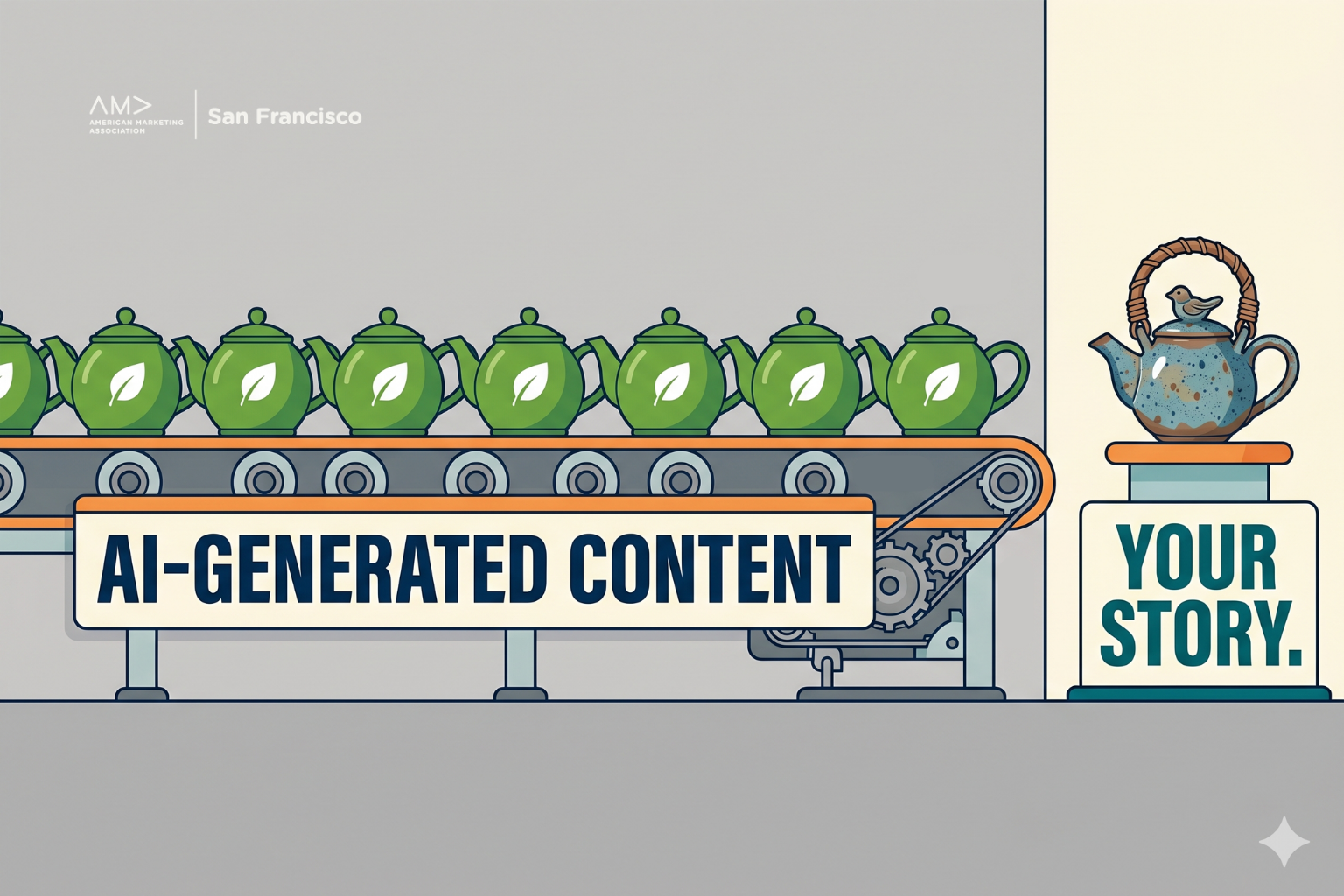
Every brand now has access to the same generative AI tools. Every brand can produce polished copy, consistent visuals, and high-frequency social content at a fraction of the cost it required two years ago. That sounds like progress — and in many ways it is — but it has also created a new and underappreciated problem. When everyone uses the same tools, the outputs start to look, sound, and feel alike. The visual standards go up while the distinctiveness goes down. Gerardo Garcia-Jurado, author of Effective Marketing Decoded, identifies this as one of the most critical challenges facing modern marketers: AI can accelerate and refine your brand expression, but it cannot originate your brand story. That part still belongs entirely to you.
What Typography, Color, and Voice Actually Communicate
Brand identity is often treated as an aesthetic exercise — pick a color palette, choose a font, write a tagline. Gerardo’s treatment of brand building in Effective Marketing Decoded goes considerably deeper. Typography, for instance, isn’t a stylistic preference. Every typeface carries psychological weight, communicates a set of associations, and shapes how a reader processes everything that follows. Getting it wrong doesn’t just make the brand look off — it creates a subtle friction between what the brand says it is and how it feels to interact with it.
The same principle applies to color psychology and the mission statement, which Gerardo frames not as a corporate formality but as the core articulation of a brand’s purpose. A mission statement written to sound good in a pitch deck is useless as a brand tool. One that genuinely captures why a business exists — what it’s trying to change or create for its customers — becomes the filter through which every content decision passes. It’s the reason a piece of copy feels right or doesn’t.
This is where AI tools hit a fundamental ceiling. They can execute within a brand system. They can generate options, apply guidelines, maintain consistency at scale. What they cannot do is supply the underlying authenticity that makes a brand story resonate in the first place. Garcia-Jurado puts it plainly: “AI doesn’t understand your story.” That’s not a criticism of the technology — it’s an accurate description of the division of labor. Humans bring the story; AI helps tell it more efficiently.
Structuring Messages That Actually Move People
Knowing your brand story is one problem. Translating that story into campaign messages that work at each stage of the funnel is another. Gerardo’s approach to campaign messaging draws on the StoryBrand framework popularized by Donald Miller, which positions the customer — not the brand — as the hero of the narrative. The brand is the guide: credible, empathetic, equipped with a clear plan that helps the customer get from where they are to where they want to be.
This framing has real mechanical implications for how marketing content is written. Most brand copy defaults to making the brand the subject: “We’ve been leaders in our industry for 20 years.” StoryBrand-informed copy flips that: “You’ve been trying to solve this problem for months. Here’s why it hasn’t worked — and what actually will.” The customer’s journey is front and center. The brand shows up as the resource that makes progress possible.
When you feed a well-articulated brand story into this structure — your one-liner, your unique value proposition, a clear description of your customer’s central conflict — and then use AI to generate messaging variations across funnel stages, the output is dramatically more precise than anything produced without that foundation. AI as a creative partner, applied to a clearly defined brand narrative, can generate awareness content, consideration content, and conversion content that all feel like they come from the same coherent story. Without that foundation, AI generates competent prose that connects to nothing.
The Authenticity Gap That AI Creates and Humans Must Fill
The flood of AI-generated content across every channel has had an unexpected effect on audiences: they’re getting better at detecting inauthenticity. Not necessarily at identifying AI-generated content specifically, but at recognizing when content lacks a genuine point of view. Brands that have invested in a clear, honest, specific story — one grounded in actual customer experience and real brand purpose — are increasingly standing out simply because most of their competitors haven’t.
This isn’t about being anti-technology. The most effective marketing teams are the ones that use AI heavily and have a strong brand story. The tools amplify whatever foundation you bring to them. A strong story gets amplified into compelling, consistent, high-volume content. A weak or generic story gets amplified into a lot of forgettable noise. The investment that pays the highest long-term return isn’t in better tools. It’s in better story clarity first, and then in deploying those tools against it.
Where the Story Actually Comes From
A brand story isn’t a creative writing exercise. It’s the answer to a few specific questions that most marketing teams have never sat down to answer in a single document — what tangible problem does the company exist to solve, what does the world look like for a customer who has solved it, and what does the company believe about how that problem should be solved that competitors don’t believe. Companies with the most resonant brand stories tend to have a leadership team that can answer those questions in plain language, without slipping into category jargon or features-and-benefits framing.
The work of capturing that story is rarely the marketing team’s alone. It pulls in founders, product leaders, and the people who actually talk to customers every day. The output isn’t a slogan or a brand book — it’s a short, honest internal document that anyone on the team can refer back to when they’re not sure whether a piece of copy or a campaign concept is on-brand. Once that document exists, the question of whether AI is “on-brand” becomes much easier to answer because there’s something concrete to compare AI output against.
Polished content produced at scale is table stakes. Brands that are winning aren’t just producing more — they’re producing work that feels like it comes from somewhere real, built on a story that AI helped tell but didn’t invent. That’s the craft worth developing, and it starts with being honest about what makes your brand worth paying attention to in the first place.
Marketing is evolving fast—and none of us should have to figure it out alone. At the American Marketing Association, you’ll find marketers sharing real experiences, hard-earned lessons, and practical frameworks for navigating change with clarity and purpose. If that sounds like your kind of community, we’d love to have you! Become a member today.




Comments are closed.