


Every product marketer has felt the pressure by now. AI tools are everywhere, adoption is accelerating, and the expectation—spoken or not—is that you are using them. The harder question is not whether to use AI. It is whether, in reaching for speed and scale, you are quietly outsourcing the things that made your launches work in the first place.
The risk is real. AI is exceptionally good at pattern recognition, copy generation, and research synthesis. It is not good at genuine empathy—at understanding the hesitation in a prospect’s voice, the frustration beneath a support ticket, or the emotional context that turns a feature into a story people want to tell. Those things require a human. And in a market where AI-generated content is increasingly indistinguishable from the average, they are also the things that will set your launch apart.
Here is how to build an AI-ready launch strategy that moves faster without losing what matters most.
Decide what AI can own—and what only you can.
Satya Nadella has described the current moment as a shift from an “autopilot era” to a “copilot era”—one where humans remain in the loop and AI amplifies their decisions. That framing is the right starting point for any launch. AI should accelerate your execution. It should not be making the calls that define your strategy.
A Human-Led, AI-Assisted split makes this concrete. Humans own the work that requires judgment and emotional intelligence: segment prioritization, positioning, narrative architecture, pricing rationale, and the story you are asking the market to believe. AI handles the work that benefits from speed and volume: competitive research, first-draft generation, copy variants, performance iteration. McKinsey’s research on generative AI estimates this kind of structured deployment can lift marketing productivity by 5 to 15 percent of total spend—but only when the division of labor is deliberate.
The failure mode to watch for is subtle. In most launch rooms, the problem is not that AI is running out of control—it is that no one wants to say the AI draft is strategically hollow. Build an AI assignment table into your launch template. Mark every task as human-led, AI-assisted, or AI-owned. Make it explicit where empathy, nuance, and final judgment stay with a person. That habit alone prevents AI from quietly absorbing the work that most needs a human.
Protect your voice before the prompting starts.
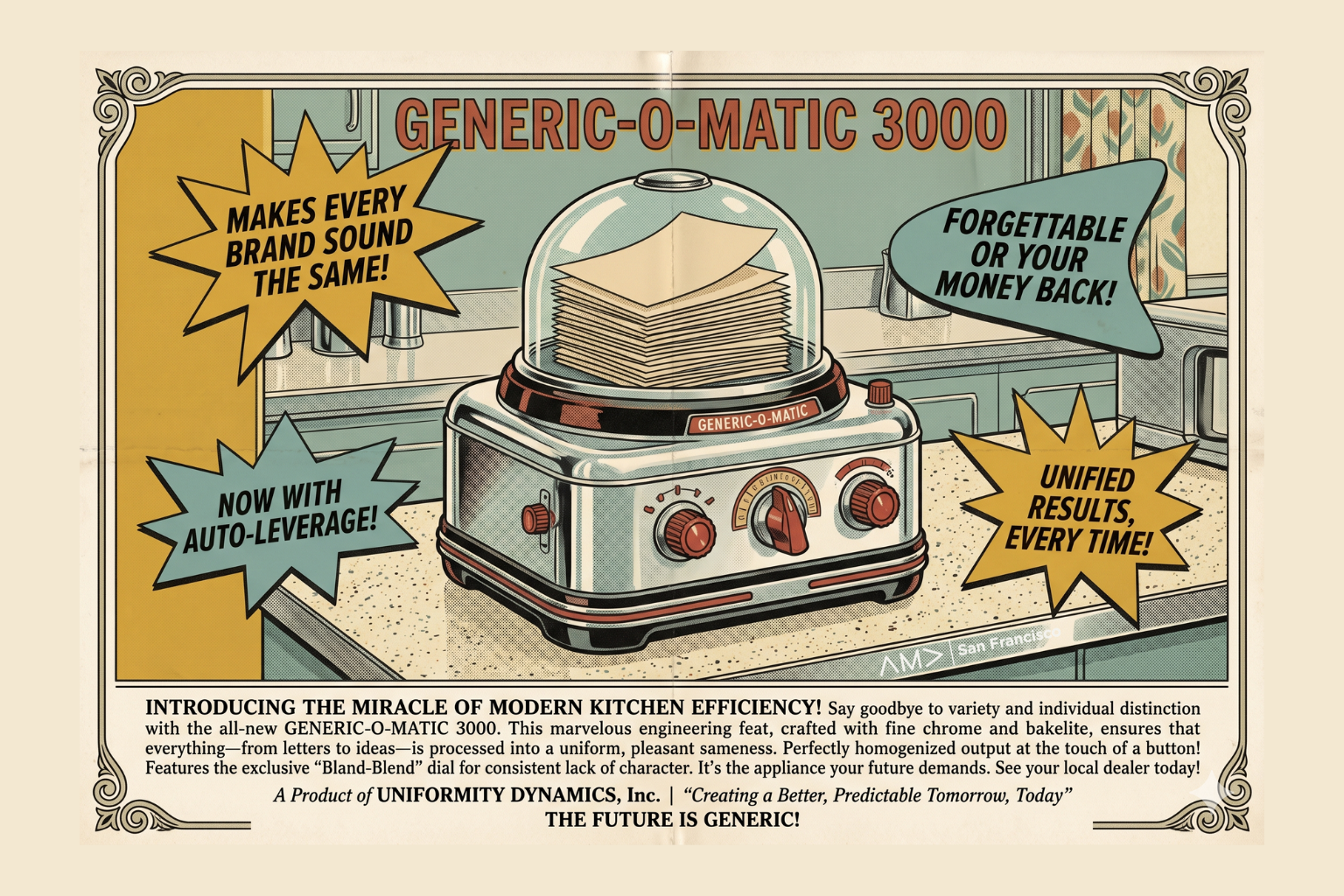
When Sundar Pichai describes AI as “the most profound technology humanity is working on,” he is also, implicitly, describing its capacity for harm when misapplied. For product marketers, the most insidious misapplication is brand erosion. The same model that can generate a month’s worth of copy in an afternoon will, without guidance, produce something that reads like every other company in your space—technically proficient, emotionally inert, and entirely forgettable.
The antidote is a Positioning Guardrails Brief written before a single prompt is entered. It should define your core value proposition, your key proof points, the claims you will never make, and concrete examples of language that sounds like your brand versus language that does not. This is the creative brief your AI works from. Without it, the model will default to the category average—and your brand will sound like it.
When the brief is in place, AI output requires editing. Without it, AI output requires rebuilding—a much more expensive problem. Convert the brief into a reusable system prompt, and your voice travels consistently across every asset, channel, and campaign your team produces.
Scale intelligently. Never outsource the story.
The business case for AI in marketing is not in doubt. McKinsey estimates generative AI could contribute as much as $4.4 trillion to the global economy annually. Salesforce’s State of Marketing report shows that the majority of marketers are already using or experimenting with AI tools, with measurable gains in speed and customer engagement.
The question is not scale—it is placement. The most effective approach draws on the logic of the barbell strategy: concentrate weight at the extremes and keep the middle as light as possible. On one end, protect the high-stakes human work—launch narrative, pricing rationale, executive messaging. On the other, lean fully into AI for high-volume tasks: subject line variants, social snippets, SEO copy. The undifferentiated middle is where generic content lives. Spend as little time there as possible.
One principle is worth treating as a rule: AI does not write the first draft of the launch story. A PMM writes the core narrative. AI then adapts it for formats, channels, and experiments. The distinction matters. A story that starts with a human carries conviction, specificity, and emotional logic. A story that starts with a prompt carries none of those things by default.
Go beyond the data to understand the person.
Reid Hoffman has described AI as a force multiplier—something that extends what people can do rather than replacing the people doing it. Nowhere is that distinction more important than in customer insight. AI is a powerful analytical tool. It is not an empathetic one.
A Dual-Loop Insight Framework keeps both functions intact. In the first loop, AI processes the signals your data already contains: win-loss notes, product reviews, support tickets, CRM patterns. It finds correlations and surfaces trends at a scale no human analyst could match. In the second loop, a human takes those patterns into direct buyer conversations—interviews, sales debriefs, customer calls—and tests them against lived reality.
The second loop is irreplaceable. Summaries and transcripts flatten the texture of a real conversation: the pause before a prospect answers a pricing question, the language someone reaches for when they are confused but do not want to say so, the enthusiasm that signals genuine product-market fit rather than polite interest. As Shep Hyken has noted in his work on customer experience, AI can scale speed and knowledge—but empathy, trust, and genuine connection remain human capabilities. The product marketers who understand that distinction will build launches grounded in real insight, not statistically averaged assumptions.
Build the governance before you need it.
The internal risk most teams underestimate is not the quality of any individual AI output. It is what happens when a dozen people are using different tools, with different prompts, and no shared standards. The assets diverge. The messaging drifts. The voice fractures. The launch arrives inconsistent—and no single person is responsible, because no one was.
Structure prevents that. Extend the DACI framework to cover AI decisions explicitly. One Driver owns the AI workflows, the approved tools, and the shared standards. One Approver signs off on brand integrity and risk. The rest of the team understands, clearly, where AI is appropriate and where a human judgment is required.
Then build review checkpoints directly into the launch calendar. Before every major milestone—press announcement, sales enablement release, executive briefing—run a single test on all AI-generated work: does this sound like something a real customer would say, or like something an AI guessed a customer might say? The gap between those two answers is where your launch’s credibility is won or lost.
What an AI-ready launch actually looks like.
An AI-ready launch is not one where every asset was touched by a model. It is one where a team thought carefully about the boundary between human judgment and machine execution—and then held that boundary through the pressure of a real launch cycle.
McKinsey’s research is consistent on this: the organizations that extract the most value from AI are not the ones deploying it most broadly. They are the ones deploying it most precisely, within structured workflows and clear governance. Breadth without discipline produces speed without coherence.
The product marketers who will distinguish themselves in the years ahead are not those who automate the most. They are those who remain irreplaceable—who bring the market understanding, the emotional intelligence, and the brand judgment that no prompt can reliably produce. AI will compress the distance between strategy and execution. But the strategy itself, and the human insight behind it, will always need to come from you.
Key Takeaways
- Own the judgment calls. AI executes well. It does not strategize well. Segment choice, positioning, narrative, and pricing logic belong with a human.
- Brief before you prompt. A Positioning Guardrails Brief is what separates AI that amplifies your voice from AI that erases it.
- Protect the story’s origin. AI does not write the first draft of the launch narrative. A human does. AI adapts what the human creates.
- Close the loop in person. AI surfaces data patterns. Real buyer conversations reveal what those patterns mean. You need both, and neither replaces the other.
- Govern before you scale. A clear DACI structure and explicit human checkpoints are what keep a launch coherent, credible, and on-brand.


Comments are closed.