


There was a time when the most important thing in music marketing was a piece of cardboard. Getting your artist’s CD onto the end cap at the front of the store – and keeping a rival rep from quietly sliding it to the back – could decide a release. Then Napster cracked the dam, streaming finished the job, and the thing labels spent decades fighting over became free. Anyone with a laptop and a garage can now be everywhere at once. So here’s the uncomfortable question every marketer eventually faces, whether they’re selling pop singles or B2B software: when distribution costs nothing and everyone has it, what exactly is your job?
In Season 1 Episode 15 of AMA SF’s Misadventures in Marketing podcast, “That’s Entertainment: The State of Music Industry Marketing”, hosts Peter and Steve sit down with Julie Ann Bornales, an 18-year Warner Music Group veteran who watched the industry travel from in-store CD displays to viral TikTok clips. Her vantage point – sales, marketing communications, creative, podcasting, and digital OTT – makes the episode less a music-industry tour than a field guide to marketing anything when the old channels collapse.
When distribution goes free, the artist becomes the product
The instinct in a commoditized world is to compete harder on the thing that’s been commoditized. The smarter move is to climb a level. Once streaming made distribution nearly free, the music itself stopped being the whole product – the artist became the product, and the artist’s brand became the asset worth building. As Steve Haney puts it, content may be king, but distribution is God; the moment that god became free to everyone, the entire game shifted to brand.
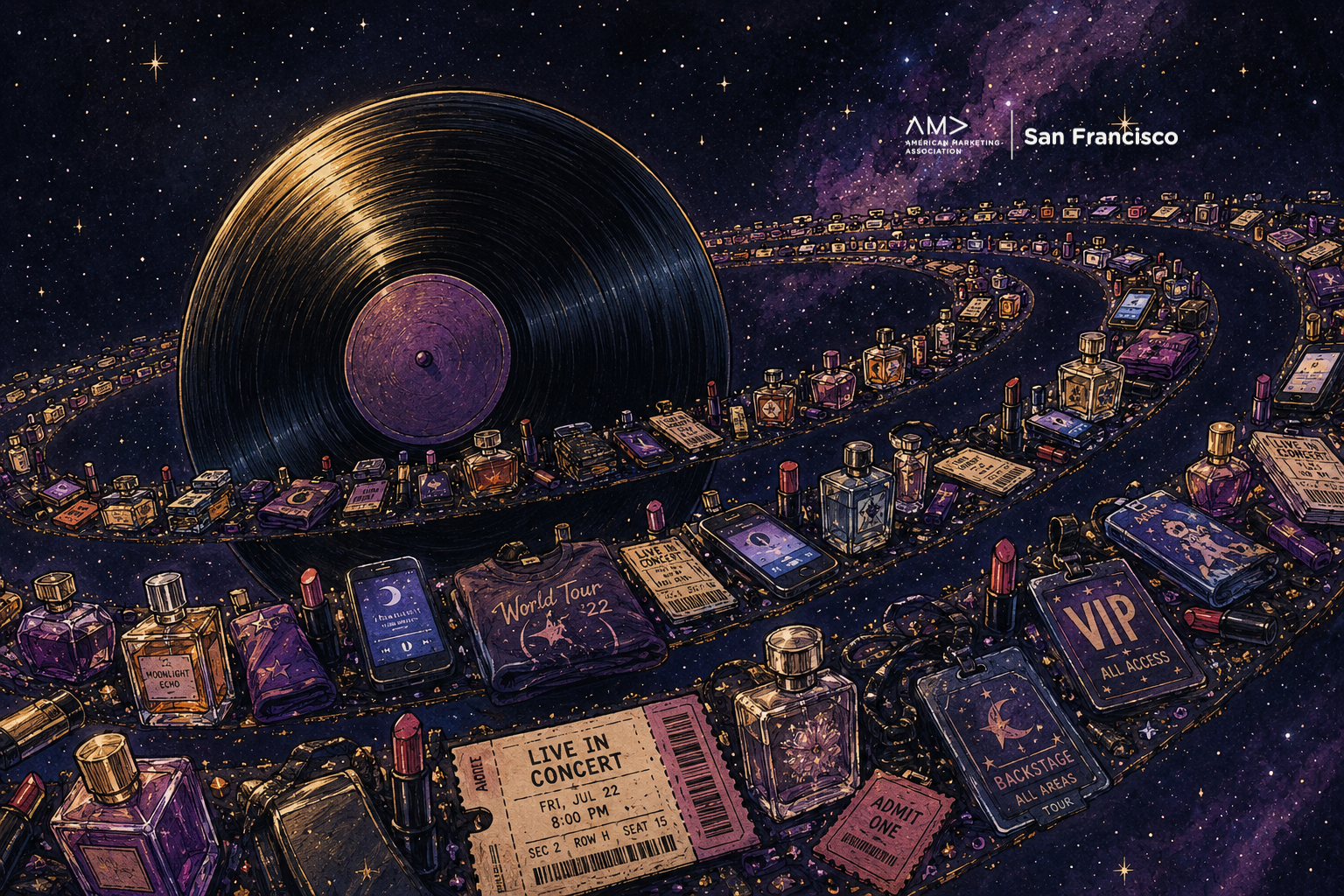
This is the logic behind the 360 deal. A label no longer signs you to make a record and ship it. It signs the whole brand and then chases every surface that brand can touch: touring, merch, social, licensing, perfume, an app. Rihanna’s billion didn’t come from her catalog – it came from cosmetics. Billie Eilish isn’t a discography; she’s tour tickets, a merch store, and a look. The marketer’s job is to find the audience and then turn casual listeners into super fans who consume across every one of those surfaces.
The artist is the customer; the audience is the consumer
One of the most clarifying reframes in the conversation is also the easiest to miss. In a record label, the artist is the customer – the thing you’re trying to take to market – and the audience is the consumer you’re placing them in front of. Hold both in your head at once and the whole operation makes sense: you are simultaneously serving the talent and courting the crowd, and confusing the two is how campaigns go sideways.
As Julie Ann Bornales frames it: “Our customer is the artist… and then the consumer is the audience that we’re reaching out to.”
It’s the same structure any marketer lives inside. Steve draws the parallel to the four Ps: discovering talent is just sourcing the product. Price, place, and promotion still have to be built around it – which is precisely what a marketer at a ten-person tech startup does with a promising technology that hasn’t found product-market fit yet. Different industry, identical problem.
Discoverability is the eternal problem
Strip away the technology and the job never actually changes: there is more supply than the audience can possibly absorb, and your task is to get the right artist in front of the right ears. The channels are unrecognizable from twenty years ago – radio and TRL gave way to a viral ten-second clip – but the supply-and-demand attention crunch is exactly what it always was.
What has changed is who holds the gate. Labels used to control the channels outright; now the relationship runs both directions. An artist can build an audience alone on YouTube or TikTok and force the industry to come signing – Justin Bieber and Lizzo essentially manufactured their own demand before the promotional machine slotted them in. The lesson for any marketer: you can no longer just push from the institution outward. You have to be ready to detect a groundswell you didn’t start and ride it before it crests.
The cool kid on the playground is now an algorithm
Peter Farago tells a story from his Electronic Arts days, when Def Jam’s marketers came to speak. Their tactic was to break a new act by getting the track into the hands of the single coolest kid in a given school – the tastemaker whose nieces, nephews, and little siblings would follow. Find the right node in the network and the song spreads on its own.
Fast-forward, and that human tastemaker has split into two descendants:
- The influencer: the modern cool kid, handed a track to build a dance, an ASMR clip, or a moment around. Sometimes paid, sometimes simply slipped the song with a “do what you want with it.” The mixtape handoff survives – it’s just a partnership now.
- The algorithm: Spotify’s recommendation engine, which is backward-looking by design and tends to feed you what you already loved in high school. Breaking a new act through it takes institutional muscle – merchandising placement, slotting, the kind of programmatic exposure an independent artist can’t buy alone.
The tactic was always about access to a trusted channel into the right audience. That hasn’t changed. What costs money to reach has.
Conversion happens later – first, plant the earworm
Here’s a counterintuitive principle worth stealing for any funnel. In music marketing, the follower count is a vanity number; a million TikTok followers will not become a million streams. The goal of the viral moment isn’t immediate conversion at all – it’s to lodge an earworm and trust the audience to close the loop themselves.
Think of the chain: a song surfaces in a skateboarding video – Fleetwood Mac’s “Dreams” riding a man drinking Ocean Spray – and a generation that never knew the band scrambles to identify it. They search the lyrics on YouTube (so your SEO had better be clean), land on the official video, and everyone in the chain gets paid, on TikTok and YouTube alike. The conversion was real; it just arrived three steps after the spark. Even the kid buying a Guns N’ Roses shirt at Target with no idea who the band is becomes a billboard the moment he walks out the door. You buy eyeballs now and monetize the connection later.
The label is a venture capitalist
The most useful analogy in the episode reframes the entire artist-label relationship. A modern label doesn’t take you from zero to sixty – it finds artists who’ve already started driving and gives them the upgrade to the next level. The best signing is someone who already knows who they are and has built their own audience; the label supplies the machine, the relationships, and the 300-person distribution arm that an independent simply can’t muster.
Peter draws the parallel cleanly: it’s not so different from a startup raising money. Having Sequoia or Andreessen Horowitz on your cap table doesn’t get the car going – the founder already bootstrapped that – but it pours gas in the tank and lends a brand name. In both cases the talent faces the identical trade: take the money and the reach, but give up some control and gain a board to answer to. Does the partnership make you bigger, or is it just buying a share of a winner you already became?
If you cut an AI, does it bleed?
Which brings us to the disruption now lapping at the industry’s feet. Generative AI makes music cheaper and more accessible, and it can absolutely rearrange the deck. Julie Ann recalls a singer-songwriter who played his new single and then played five prior top-ten hits built on the same chords – proof, he argued, that the song would work because it had already worked five times. AI is that instinct industrialized: it can only recombine what already exists, producing a confident copy of a copy.
But a copy is not a connection. The reason a boy band lands or flops, the reason a forty-year-old still feels sixteen listening to Taylor Swift, is a human bond that recombined chord progressions can’t fake. The genuine AI wins – the resurrected John Lennon vocal, the Randy Travis song rebuilt after his stroke – work precisely because a real human’s history and audience were already there for the technology to serve. It’s a remarkable instrument. It is not the artist.
So the closing question is the one Steve keeps returning to, and it’s the right one to leave with whether you market music or anything else: in a world where a machine can generate an infinite supply of competent, soulless content for free, where will you put the thing only a human can provide? Because that – not the distribution, not the chords, not the algorithm – is the part nobody can commoditize.
Listen to the full podcast on Spotify and Apple Podcasts.
Check out summaries from other episodes:
- The New CMO Playbook: A Guide To The First 90 Days
- Resilience, Discipline, and Reputation: Lessons for Leaders
- Marketing Leadership in the Age of AI
Misadventures in Marketing is a weekly podcast by the AMA San Francisco chapter. Veteran Silicon Valley marketing execs Peter Farago and Steve Haney explore the messy, rewarding, and occasionally absurd world of high-tech marketing – especially in early-stage startups. Each episode covers real-world challenges, trends, and lessons from the front lines.



Comments are closed.