


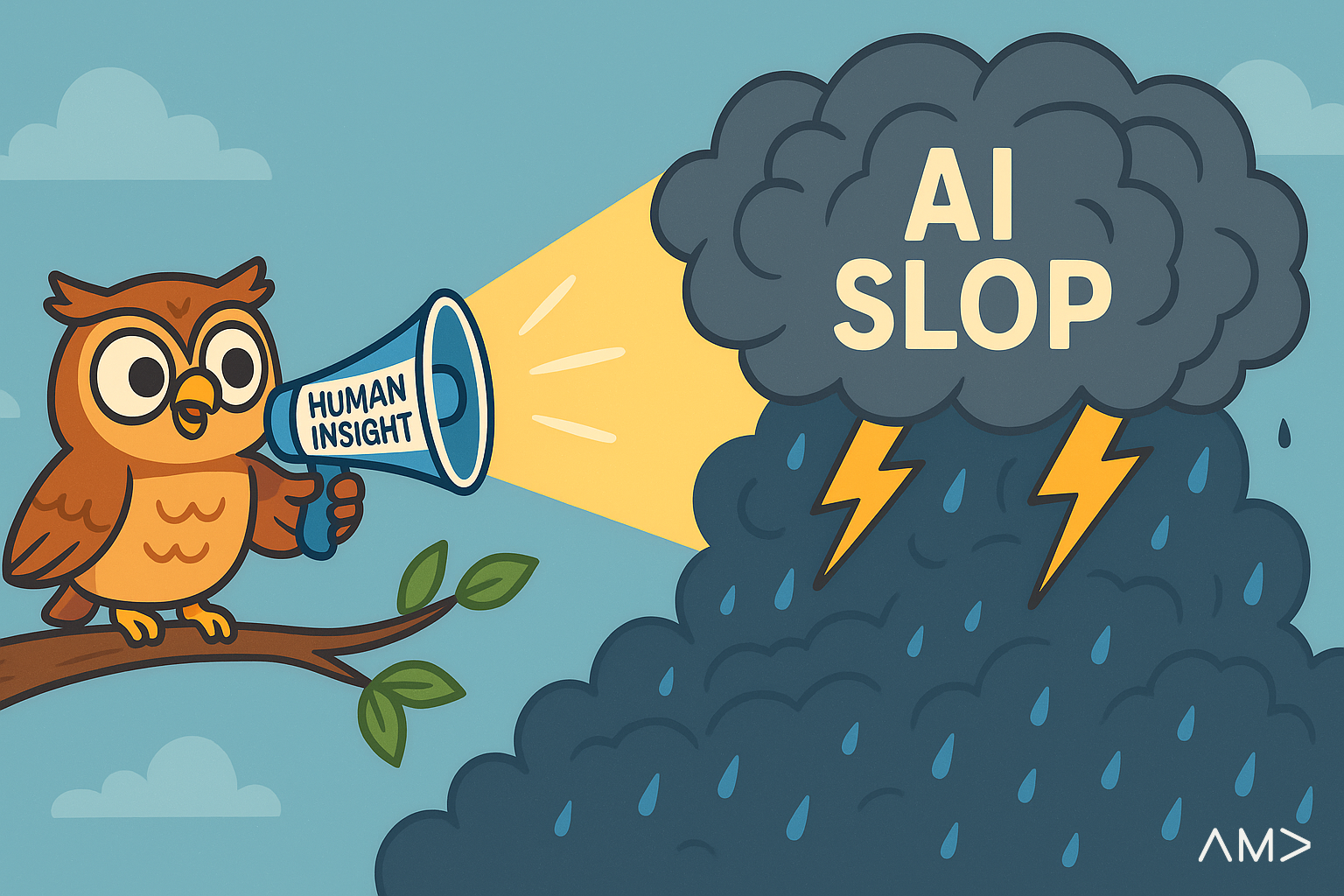
In Episode 7 of Misadventures in Marketing, hosts Peter Farago and Steve Haney dive deep into one of the biggest tensions in marketing today: AI has made content creation cheap, fast, and endlessly scalable—yet capturing attention has never been more difficult.
As Peter puts it, “Content is so cheap to create now, but as a result, trust got a lot more expensive.” A SurveyMonkey study found 88% of marketers rely on AI in their day-to-day work, with 93% using it to generate content faster. 50% of marketing teams already use AI to create content (and 45% use it to brainstorm ideas). At the same time, the web is being flooded with what the internet has lovingly dubbed “AI slop”—high-volume, low-differentiation content optimized for machines instead of humans. This has created a vicious cycle: more content → less signal → more noise → even more content to break through.
Steve sums it up clearly: “The unique human spark—imagination, original insight—that’s the thing AI can’t replicate. And ironically, the easier AI makes production, the more valuable that human ingredient becomes.”
Why Fighting Fire with Fire Isn’t Optional
Both hosts acknowledge the reality: you can’t opt out of AI. Peter shares how he uses AI to accelerate research, structure long-form content, and speed up editorial workflows—but never without layering human originality on top. Even for interpersonal communication, he uses ChatGPT as a personal “tone check” to remove emotion and avoid snark in high-stakes email threads—an unexpectedly universal use case.
Meanwhile, Steve highlights his daily reliance on NotebookLM, especially now that it accepts Google Sheets, enabling data-rich research notebooks that feel more like “agentic workspaces” than chatbots. This hybrid workflow—AI for acceleration, humans for authenticity—is becoming the new standard.
This bifurcated model mirrors what Steve and Peter describe: AI handles the drudgery, humans handle the judgment.
The Crisis of Distribution: Quality Isn’t Enough
Here’s the uncomfortable truth the hosts confront head-on: even high-quality content is struggling to break through.
Peter has spent six months producing well-researched, insight-first writing—refined, reviewed by his CEO (a subject matter expert), and rooted in original thinking. Despite this, he muses, “It’s getting engagement, but it’s not really widening the audience… What worked two years ago isn’t working now.”
This matches industry behavior: with AI tools enabling unlimited content creation, distribution has become the primary bottleneck, not creation. Steve emphasizes this too: “We’ve solved half the problem—production. Distribution is now the real war.”
So What Still Works? Based on their conversation, a few signals still cut through:
1. Founder-Led Content: Research shows that 82% of consumers are more likely to trust a company when its leadership is active on social media. Peter confirms this from experience: “People want to follow people, not companies.”
2. Practitioner Voices: Steve references Google’s EEAT framework—Experience, Expertise, Authoritativeness, Trustworthiness—as the backbone of modern content credibility. In other words: real humans with real stories win.
3. Research-Driven Content with New Insight: Peter notes that true differentiation increasingly requires new data or new analysis, not just summaries. He specifically cites how high-quality research reports still earn backlinks—one of the only remaining durable SEO signals.
4. Multi-Format Storytelling (Especially Vertical Video): Even though neither host is obsessed with video, they acknowledge the reality: short-form vertical video outperforms almost every other organic format—especially on LinkedIn, YouTube Shorts, and TikTok.
Steve jokes that LinkedIn becoming TikTok for professionals feels inevitable… and his frustration with birthday posts is universally relatable. Peter shares that high-production-value videos—especially featuring multiple experts—saw far better reach because of co-marketing and shared audiences.
Authenticity, Consistency, and Curation: The Winning Formula
When you distill their arguments, the winning strategy in the age of AI slop comes down to three things:
1. Authenticity: Be opinionated. Have a stance. Take a stand. This is how you reintroduce humanity into your content.
2. Consistency: You can’t post once a month and expect to win. Audience building is slow, steady, cumulative work.
3. Human Curation: AI output without human input will always sound like everyone else. What separates “AI-assisted editorial excellence” from “AI slop” is simply—a human who cares enough to shape it.
This entire episode, in fact, demonstrates a meta-lesson: AI helps you work faster, but only humans help your work matter.
🎧 Tune in now to Season 2, Episode 7: Board Tales: How to Win the Room
👉 Listen to the podcast on Spotify and Apple Podcasts.
📚 Check out summaries from other episodes:
- Board Tales: How CMOs Win the Room When Every Second Counts
- Mind the Gap: Why So Many Leads Die Between MQL and SQL
- GTM Strategy in the AI Era: Plan, Punch, Pivot
Misadventures in Marketing is a weekly podcast by the AMA San Francisco chapter. Veteran Silicon Valley marketing execs Peter Farago and Steve Haney explore the messy, rewarding, and occasionally absurd world of high-tech marketing — especially in early-stage startups. Each episode covers real-world challenges, trends, and lessons from the front lines.


Comments are closed.