


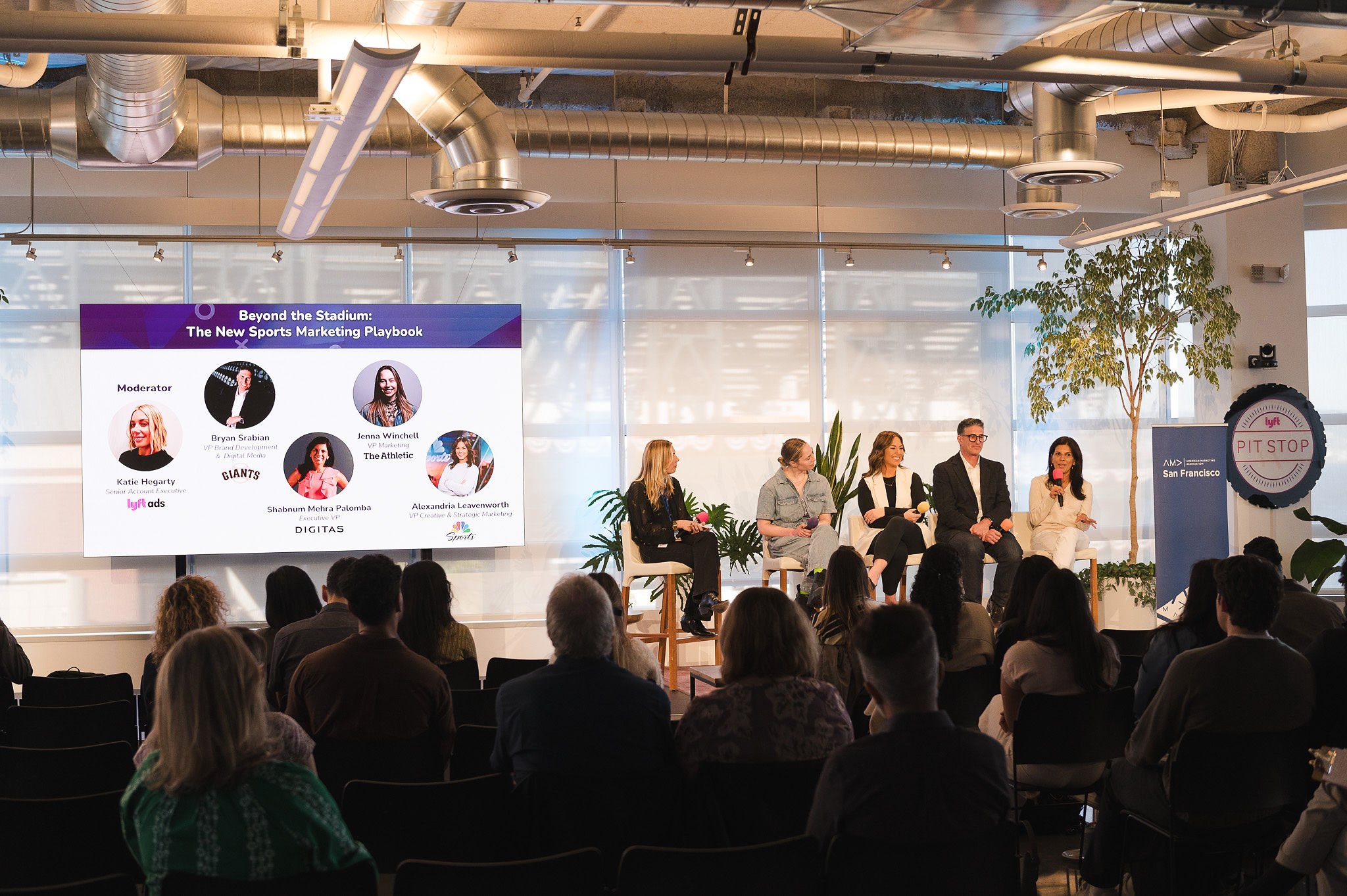
This is Part 2 of AMA San Francisco’s Playmakers event recap series exploring the new playbook for sports marketing. In Part 1, we examined how community identity drives the success of Bay Area sports brands and why belonging often proves more powerful than traditional marketing campaigns.
Part 2 shifts the focus to brand partnerships, one of the fastest evolving areas in sports marketing. Sports sponsorships once revolved around visibility: logos on jerseys, stadium signage, and broadcast placements designed to maximize impressions. That model worked when television dominated media distribution and fan engagement followed predictable patterns.
Today’s sports partnerships look very different. Modern collaborations require shared storytelling, experiential activation, and deeper integration between brands, teams, and fans. The leaders speaking at Playmakers described a sponsorship landscape that increasingly resembles creative collaboration rather than advertising.
Sponsorship Is No Longer Just a Logo
For decades, sports sponsorship followed a straightforward formula. Brands paid for exposure across uniforms, stadiums, and televised games. And in turn, marketing teams evaluated success through broadcast reach, brand recall, and impression counts. That formula still exists, of course, but it no longer defines the value of a partnership. As a result, sports organizations are building stronger direct relationships with fans, and consequently, sponsors must contribute more than visibility alone. Instead, teams now look for partners who can enhance the fan experience, contribute to storytelling, and participate meaningfully in the cultural ecosystem surrounding the sport.
Throughout the Playmakers discussion, speakers emphasized that passive sponsorship rarely creates memorable brand impact anymore. After all, fans do not simply watch sports. Rather, they participate in communities, attend events, follow athletes on social platforms, and engage with content across multiple channels. Partnerships must therefore operate across all of those environments simultaneously.
Celessa Baker, VP of Marketing Partnerships at SEPHORA described the shift in practical terms. Sephora didn’t enter sports looking for logo placements. They entered looking for cultural moments and found them in unexpected places, like Warriors fans competing to grab Sephora gift bags dropping from the arena ceiling. The brand’s reach, she noted, comes from showing up in ways that feel like a natural part of the fan experience rather than an interruption to it.
The Three-Way Partnership Model: Team, Brand, Fan
Modern sports partnerships succeed when they deliver value across three audiences simultaneously:
- The team gains revenue, credibility, and strategic support.
- The brand gains access to engaged communities and cultural relevance.
- The fan gains experiences that enhance the emotional connection with the sport.
When one of those audiences receives little value, the partnership often struggles. Marketing leaders must design collaborations that create benefits for all three groups. Instead of inserting advertising into the sports experience, brands participate in it.
As Brenden Mallette, Chief Revenue Officer at Bay Football Club put it, teams are now evaluating partnerships through a shared value lens: “We need to make sure that we’re looking at every partnership we do through this lens to say, is the team, the brand, and the fan benefiting from this relationship? … Are we making sure that nobody is debiting their equity for the sake of this relationship?”
A partnership might integrate product storytelling into fan festivals, digital content series, or behind-the-scenes storytelling with athletes. In those moments, the brand becomes part of the narrative rather than an interruption. Fans quickly notice when brands contribute meaningfully to the ecosystem surrounding their teams. They also notice when they do not.
Partnerships Must Produce Experiences
One of the clearest themes from the Playmakers discussion involved the growing importance of experience design in sports marketing. Fans tend to remember moments more than advertising placements. They remember moments. Partnerships therefore focus on creating interactions that fans can participate in, share, and talk about long after the game ends.
As Edreece Arghandiwal, Co-Founder and Chief Marketing Officer at Oakland Roots put it, “I think people in today’s day and age, with so much going on, and technology advancing the way it is (with) AI, there’s so much noise. The world is going to tend towards creating experiences that bring people together and tap into the five senses.”
Those experiences matter even more in women’s sports, where the opportunity to invest in athletes is still wide open. Brenden Mallette, Chief Revenue Officer of Bay Football Club noted that Bay FC became the first NWSL club to provide single occupancy hotel rooms for players, a decision the organization is proud to have made early. Showing up for athletes in meaningful ways, he noted, creates authentic stories that spread on their own.
Brands now collaborate with teams to produce fan festivals and experiential installations exclusive behind-the-scenes access, digital creator collaborations, athlete meetups and community events and content series that live beyond the stadium. These activities transform sponsorships into something more dynamic. Experiential marketing also amplifies reach organically. Fans share memorable experiences across social platforms, extending the visibility of the partnership far beyond the stadium. A single activation can produce thousands of pieces of user-generated content that reach audiences traditional advertising might never touch.
Measuring Sponsorship Success
As partnerships continue to evolve, measurement frameworks must evolve alongside them. While traditional sponsorship metrics once focused heavily on broadcast impressions and logo visibility, they now offer only a partial view of performance. Although these metrics still provide useful signals, they no longer capture the full impact of today’s collaborations.
As a result, marketing teams are increasingly evaluating partnerships across a broader and more nuanced set of indicators, including fan engagement during events and activations, social media amplification and user-generated content, digital content consumption and sharing, community participation in programs, as well as overall brand sentiment and reputation impact.
Shabnum Mehra Palomba, Executive VP at Digitas, noted that the audience response to these activities is striking in its consistency. Her team hears overwhelmingly positive reactions, with fans lighting up around in-arena brand moments in ways that other cultural events, even major ones like Coachella, don’t reliably produce. “Sports does this in a way that almost no other cultural moment does,” she said. “It’s been very telling for us, switching over to more sports integrations, to see that love and community come through the fans.”
Many organizations also evaluate long-term brand equity, measuring how partnerships influence trust, loyalty, and audience perception over time. Data remains essential, but marketing leaders recognize that the most powerful sponsorship outcomes often emerge through community engagement and storytelling.
The Next Era of Brand Partnerships
Sports marketing teams continue to experiment with new partnership models as media, technology, and culture evolve. Digital platforms allow brands to collaborate more deeply with teams, athletes, and creators. Fans now interact with sports through highlights, social media, live events, and community gatherings that extend well beyond the stadium.
The leaders speaking at Playmakers made one idea particularly clear. The old sponsorship model focused on visibility. The new model focuses on participation. Organizations that adapt to this shift tend to build stronger partnerships and deeper relationships with the communities that surround modern sports.
➡Read Part 3: From Broadcast to TikTok: The New Era of Sports Storytelling
The final article in this series explores how social media, creator culture, and digital platforms are reshaping the way sports organizations connect with fans.
Playmakers Bay Area Sports Marketing Summit was held on March 11, 2026 at Lyft HQ with the following list of esteemed speakers:
Session 1: Building a Brand: Inside the Rise of Bay Area Teams
Moderator: Carolyn McArdle, PA Announcer for the San Francisco Giants and co-host of the Morning Breeze on 98.1 The Breeze
- Kim Trinidad, VP Marketing & Operations, Golden State Warriors
- Edreece Arghandiwal, Co-Founder and Chief Marketing Officer, Oakland Roots
- Brenden Mallette,Chief Revenue Officer,Bay Football Club
- Celessa Baker, VP of Marketing Partnerships, SEPHORA
Session 2: Beyond the Stadium: The New Sports Marketing Playbook
Moderator: Katie Hegarty, Sales Lead, Lyft Ads
- Alexandria Leavenworth, VP, Creative and Strategic Marketing, NBC Sports Bay Area & California and NBC Bay Area
- Shabnum Mehra Palomba, Executive VP, Digitas
- Bryan Srabian, VP of Brand Development and Digital Media, San Francisco Giants
- Jenna Winchell, Managing Director, Marketing, The Athletic
Huge thank you to our amazing sponsors Lyft Ads, iHeartMedia, StackAdapt, Life360 Ads, Causal, Justin Chu Photography, Peakbound Studio, and our annual sponsor, Workbox for helping bring this event to life.
Marketing is evolving fast—and none of us should have to figure it out alone. At the American Marketing Association, you’ll find marketers sharing real experiences, hard-earned lessons, and practical frameworks for navigating change with clarity and purpose. If that sounds like your kind of community, we’d love to have you! Become a member today.




Comments are closed.