


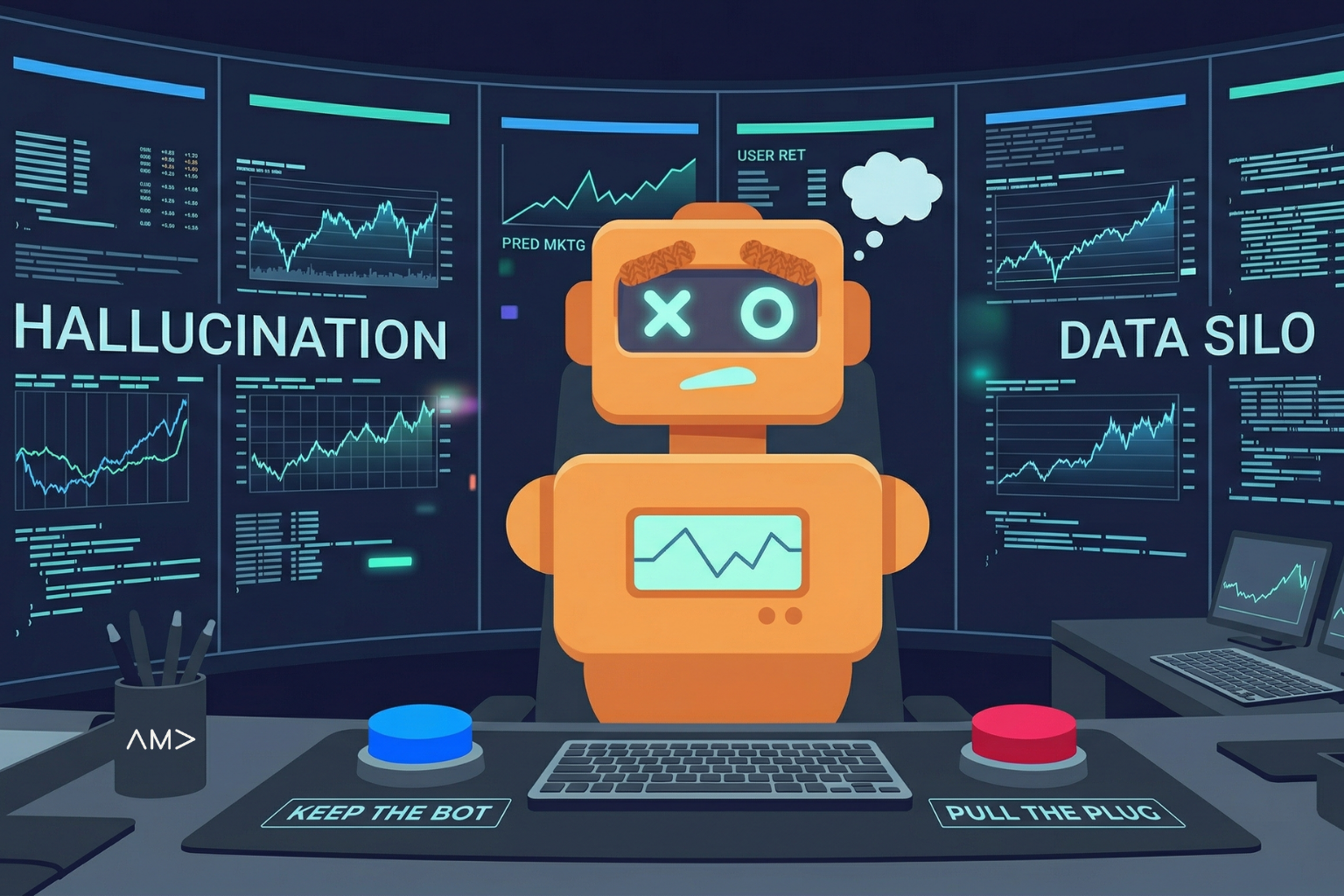
For more than a decade, website chatbots have been a staple of digital marketing and sales strategy. They promised a simple value proposition: intercept visitors, answer questions, and help move prospects from mid‑funnel curiosity to bottom‑funnel conversion. For many marketers, chatbots were the first real attempt at conversational marketing at scale.
But the landscape has shifted dramatically. Consumer behavior has evolved, AI has matured, and the expectations for digital experiences have never been higher. As a result, many companies are quietly asking a once‑unthinkable question: Should we remove our chatbot altogether?
Based on recent consumer research and the rapid evolution of AI‑powered chat, now is the perfect moment for marketers and sellers to re‑examine their chatbot strategy — not just to optimize it, but to fundamentally rethink what role conversational AI should play in the customer journey.
The Original Promise of Chatbots — and Where It Fell Apart
When chatbots first appeared on websites, they were positioned as a digital concierge. Sales reps were trained to monitor website traffic, engage visitors in a non‑intrusive way, and offer help with product questions, use cases, pricing, and the purchase process.
In theory, it was a win‑win:
- Visitors received real‑time support
- Sales teams could accelerate funnel progression
- Companies could capture more leads
In practice, the experience was inconsistent.
Some visitors appreciated the assistance. Others found it intrusive or “creepy,” especially when the chat popped up before they had even explored the site. Many visitors didn’t want to talk to a salesperson at all — they wanted a faster way to navigate the site or a shortcut to information they couldn’t easily find.
On the business side, the operational model was equally uneven. Large enterprises with high traffic volumes could justify dedicated chat teams. But mid‑market and smaller companies struggled. Sales reps often felt their time was better spent elsewhere, and the responsibility for chat frequently fell to junior staff or outsourced teams.
The result:
- Long wait times
- Poorly trained agents
- Inaccurate or inconsistent information
- Experiences that didn’t reflect the brand
For many companies, the chatbot became a cost center rather than a conversion engine.
Where Chatbots Actually Worked: Customer Support
While sales‑driven chat struggled, customer service chatbots found more success.
Support interactions are:
- More predictable
- More repetitive
- Easier to automate
- Less emotionally charged than sales conversations
Customers visiting a site for help often want:
- Troubleshooting guidance
- Product usage information
- Return or warranty support
- Order status updates
In these scenarios, a chatbot can reduce operational costs and improve response times. It can also deflect simple inquiries and route more complex issues to human agents.
But even in support, the experience wasn’t perfect — and consumers noticed.
What Consumers Really Think: Insights From a Recent Survey
In a recent survey of more than 75 consumers about their interactions with website chatbots — both sales‑focused and support‑focused — several themes emerged that marketers should pay close attention to.
- Consumers primarily see chatbots as support tools, not sales tools.
Most respondents had used chatbots in the past, but very few found them helpful in making a purchase decision. The only exception: when they already knew what they wanted and had a quick question about pricing, terms, or payment.
- Consumers prefer self‑service and unbiased information.
Respondents overwhelmingly said they rely more on:
- Independent reviews
- User‑generated content
- Product commentary from real customers
They expressed skepticism about fake reviews, but also confidence in their ability to spot them. Consumers have become more sophisticated — and more discerning.
- Poorly trained chatbots have damaged trust.
Many respondents described frustration with having to explain their issue multiple times — first to the bot, then again to a human agent. This created a negative impression of the brand itself.
- Consumers expect chatbots to “know them” — and are disappointed when they don’t.
They assumed the chatbot would have access to:
- Their past interactions
- Their preferences
- Their purchase history
When the bot didn’t, it felt disconnected from the company’s data ecosystem.
- AI‑powered chatbots introduced new problems: hallucinations.
Consumers reported noticing more AI hallucinations — incorrect or fabricated answers — and found them unacceptable. Because they interact with AI tools daily, they can now tell when AI is “faking it.”
This is a critical insight: consumer AI literacy has increased faster than many companies’ AI maturity.
Why Some Companies Are Removing Their Chatbots
Given these challenges, some companies — especially mid‑market and smaller organizations — are removing chatbots entirely. They’ve concluded that:
- Customer satisfaction dropped
- Chat volume didn’t justify the cost
- The experience hurt brand perception
- AI hallucinations created risk
- Human teams couldn’t maintain the bot effectively
For these companies, removing the chatbot isn’t a step backward. It’s a strategic reset.
For Companies Keeping Their Chatbots: Two Paths Forward
If a company decides to keep or reinvest in its chatbot strategy, there are two viable paths.
- Strengthen the Human‑Assisted Chat Model
This means:
- Training human agents more thoroughly
- Reducing handoff friction
- Giving agents access to richer context and data
- Ensuring the chatbot captures and passes along relevant information
- Prioritizing fast resolution and high‑quality interactions
This model works best for companies with:
- High‑value products
- Complex sales cycles
- Strong customer experience teams
- Invest in a More Mature AI‑Powered Chatbot
If AI is part of the strategy, companies must treat it as a living system — not a “set it and forget it” tool.
This requires:
- Training the model on enterprise‑wide data
- Including sales, marketing, and support scenarios in training
- Testing edge cases and failure modes
- Choosing the right underlying AI model
- Continuously monitoring chatbot behavior
- Updating training data regularly
- Having humans in the loop to correct and guide the system
Most AI chatbot failures happen because the bot was trained on too little data, the wrong data, or outdated data. AI is only as good as the ecosystem supporting it.
A New Framework for Rethinking Chatbots in 2025 and Beyond
Marketers should evaluate their chatbot strategy through three lenses:
- Consumer Behavior
- Do your customers want to chat?
- Are they seeking support, sales help, or navigation shortcuts?
- Are they AI‑literate and sensitive to hallucinations?
- Business Model
- Do you have the traffic volume to justify chat?
- Can you staff or support a hybrid human‑AI model?
- Is the chatbot improving or hurting customer satisfaction?
- AI Readiness
- Is your data unified and accessible?
- Do you have the ability to monitor and retrain the bot?
- Can you prevent hallucinations and maintain accuracy?
If the answer to any of these is “no,” it may be time to pause or rethink your approach.
The Bottom Line: Chatbots Aren’t Dead — But the Old Model Is
The question isn’t whether chatbots still have value. They do. But the era of generic, lightly trained, disconnected chatbots is over.
Today’s consumers expect:
- Personalization
- Accuracy
- Context awareness
- Seamless handoffs
- AI that behaves intelligently
Marketers and sellers must decide whether they’re ready to deliver that level of experience — or whether it’s time to step back, simplify, and rebuild.
The companies that succeed with AI chatbots on their website in the future will be the ones that treat them not as a cost‑saving shortcut, but as a strategic extension of their brand, their data, and their customer experience philosophy.
Marketing is evolving fast—and none of us should have to figure it out alone. At the American Marketing Association, you’ll find marketers sharing real experiences, hard-earned lessons, and practical frameworks for navigating change with clarity and purpose. If that sounds like your kind of community, we’d love to have you! Become a member today.




Comments are closed.