


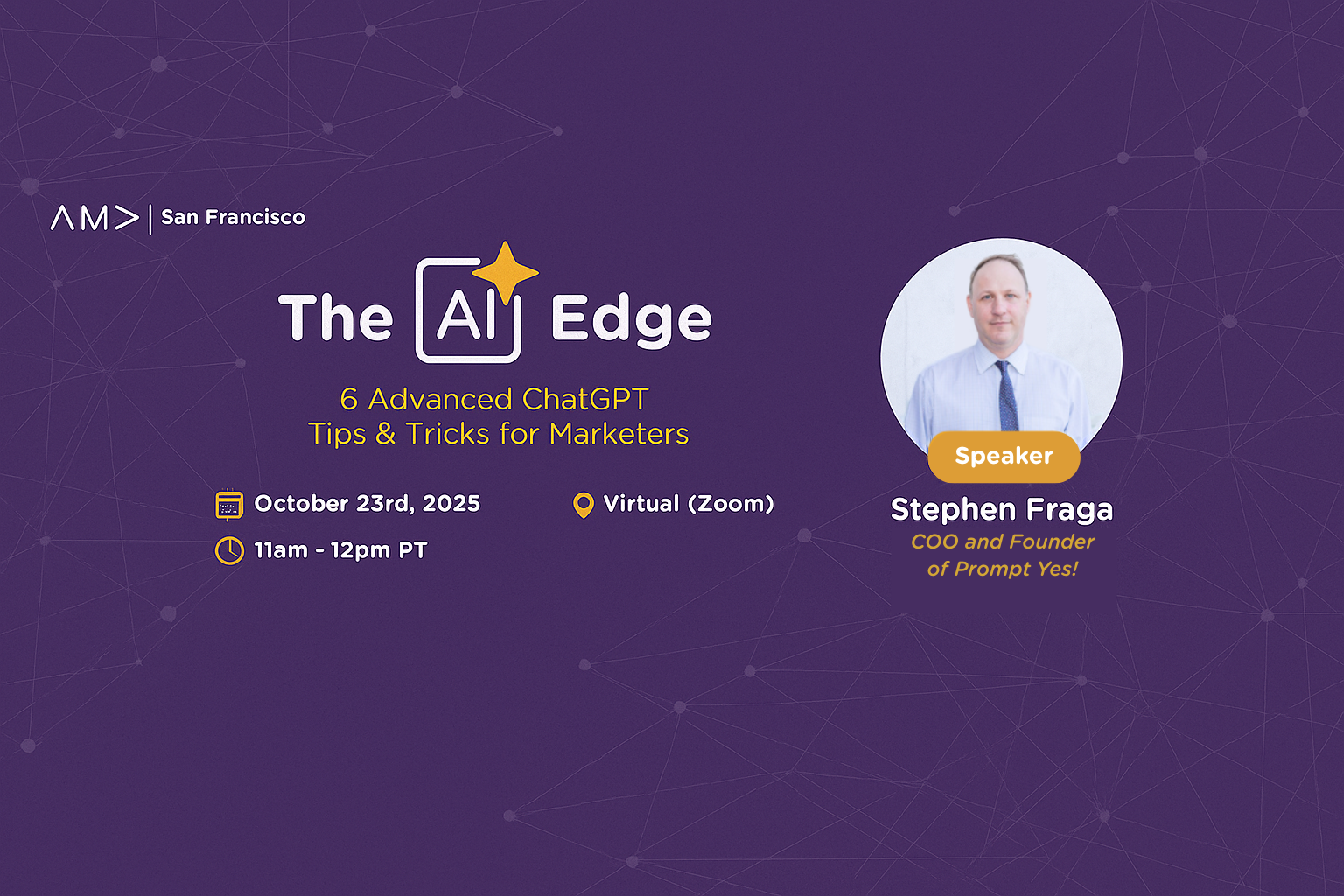
AI is creating opportunities for marketers to succeed on the job in new ways. Recently, the AMA San Francisco Chapter partnered with Steven Fraga of Prompt Yes! to host “The AI Edge,” a hands-on workshop that showed how marketers can use AI to effectively to drive creative and strategic impact.
How AI is Transforming Marketing Workflows
During the session, Steven demonstrated real-world marketing use cases for ChatGPT and several specialized GPTs, illustrating how AI can serve as both a creative partner and a strategic accelerator. Throughout the workshop, he alternated between live demos and practical insights, encouraging participants to experiment directly in ChatGPT alongside him. Here are the highlights:
AI-Powered Research & Sentiment Analysis
GPTs like AskReddit and WebPilot allow marketers to uncover audience sentiment, identify trending topics, and analyze competitor content—all of which are useful for building compelling campaigns. Steven emphasized that traditional data dashboards rarely capture why people feel the way they do. On the other hand, Reddit-driven sentiment and natural-language search can help marketers uncover emotions, pain points, and cultural cues hidden in plain sight.
Content Creation at Scale
Attendees observed how ChatGPT can generate authentic LinkedIn comments, engaging ad copy, and persuasive Google Ads headlines within minutes, while still maintaining brand voice and tone. Steven reminded marketers that the goal isn’t to automate creativity but to amplify it—using AI for ideation, A/B testing, and performance refinement. He also shared examples of how AI can summarize webinars or long-form content into social posts and email snippets, making it a force multiplier for lean teams.
Data-Driven Strategy with Deep Research
ChatGPT’s Deep Research feature enables precise audience segmentation and market discovery—unlocking richer insights for campaign planning. Steven demonstrated how marketers can identify new customer segments, analyze emerging market trends, and even scrape verified data from the internet to inform B2B outreach. He positioned Deep Research as a bridge between marketing intuition and quantifiable insight, showing how AI can supplement data analytics with context and narrative.
Visual Storytelling with AI
Using prompt-based image generation and Canva integration, marketers can now create on-brand visuals faster than ever. Steven showcased how to develop cohesive campaign aesthetics—teaching attendees how small prompt tweaks can influence mood, tone, and color consistency. While current editing limitations in Canva remain a challenge, he discussed workarounds such as exporting layers for advanced design refinement, underscoring how AI can accelerate creative production cycles.
No-Code Innovation (“Vibe Coding”)
The session concluded with an introduction to “vibe coding” which essentially means no-code, AI-assisted creation. He showcased how marketers can build lightweight AI-powered tools—like pricing calculators, engagement dashboards, or creative generators—without writing a single line of code. These prototypes not only streamline workflows but also demonstrate how marketing and product development are converging in the age of automation.
Key Takeaways for Marketers
Ultimately, AI is most powerful when marketers treat it as a co-creator rather than a replacement. It’s an accelerator for insights and imagination—not a shortcut for strategy. Here are Steven’s key takeaways:
- Be data-conscious. When using third-party plug-ins, always understand where your data flows and adopt safe sharing practices. Protecting proprietary data and client information is essential when working with AI integrations. Steven cautioned that marketers should verify data permissions before experimenting with new GPTs.
- AI expands creativity. Use it to explore bold ideas, brainstorm fresh campaign angles, and speed up experimentation. The best results come from iterative prompting—asking follow-ups, revising context, and combining data with intuition. AI thrives in open-ended creative prompts that help uncover unexpected insights.
- Prompt mastery matters. Learning to refine prompts—or even asking AI to optimize your prompts—consistently yields stronger results. Steven suggested building a personal “prompt library” for recurring marketing tasks like press releases, SEO summaries, and email sequences.
- Experiment with integrations. Combining ChatGPT with tools like Canva, Google Sheets, or analytics dashboards can turn AI from a chat interface into an execution engine. Marketers who explore integrations early will be better equipped to scale their output.
- Keep the human touch. AI excels at pattern recognition and efficiency, but authenticity still wins. Steven encouraged marketers to treat AI-generated drafts as creative foundations that need human judgment, empathy, and brand nuance.
About the Speaker
Steven Fraga is the founder of Prompt Yes!, which offers hands-on training in ChatGPT, Microsoft Copilot, Midjourney, “vibe marketing,” and AI-powered coding. He specializes in teaching professionals how to apply AI tools to real marketing challenges—from social media planning and ad optimization to prompt engineering and design integration. Learn more at promptyes.com.
What’s Next at AMA SF
AMA SF continues to lead conversations at the intersection of marketing and innovation. Don’t miss our upcoming events:
- AMA SF Holiday Party on December 11th – Tiki style!
- Career Accelerator – Modern Marketing Job Hunt on January 29th
- Sports Marketing Showdown on February 11th
Stay connected with the Bay Area’s marketing community and explore future programming at amasf.org.

Comments are closed.