


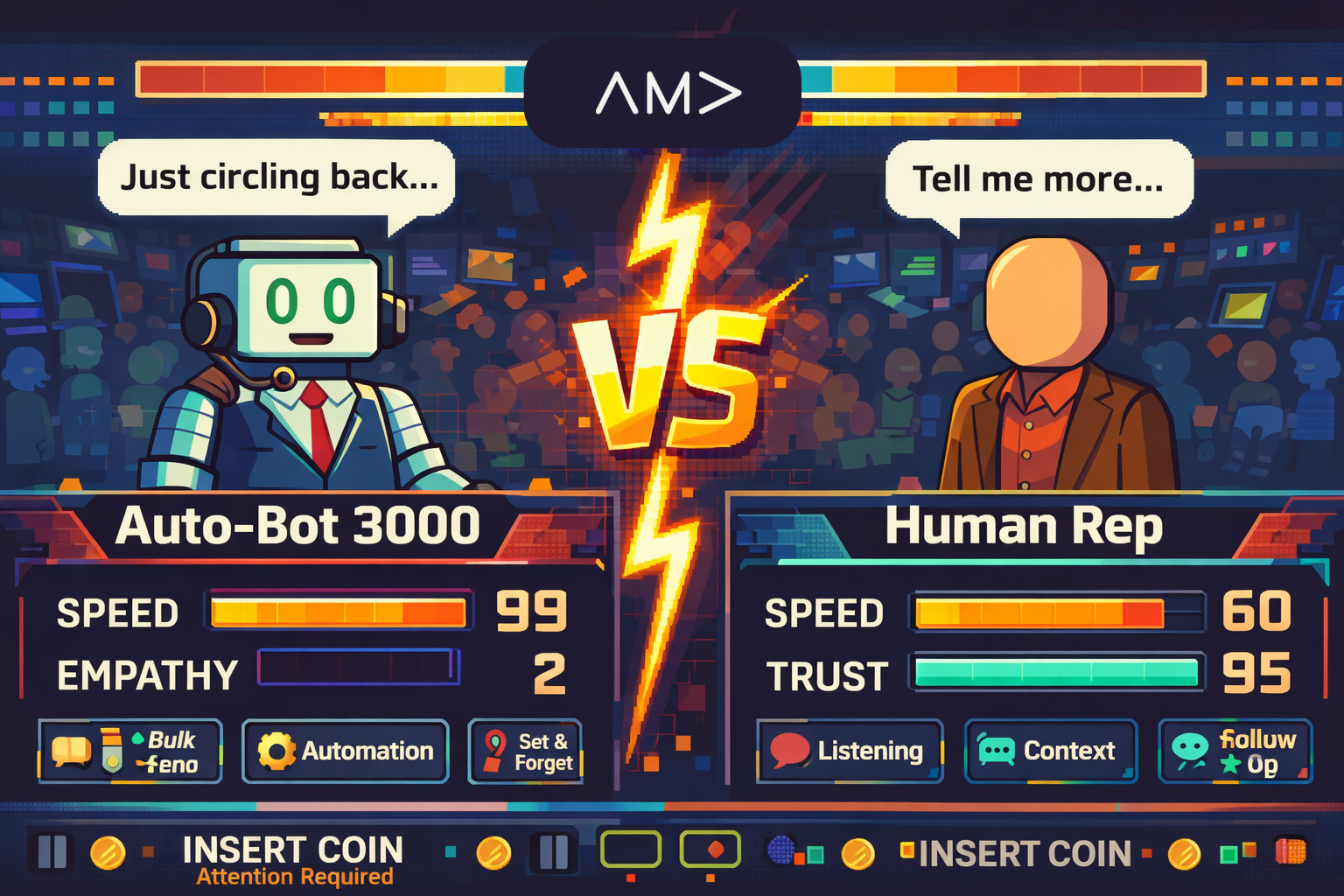
We are only a few days into 2026, and the “AI Outreach Gold Rush” is already in full swing. My inbox is living proof.
Everywhere you look, companies are leveraging AI to automate their GTM motions, hoping to find that magic button that scales revenue overnight. But here’s the reality I’m seeing on the receiving end: while the technology has advanced, the execution is often falling flat. We’ve entered the “uncanny valley” of sales—outreach that looks personalized at a glance but feels robotic, disjointed, and occasionally just plain weird the moment you actually read it.
AI is a powerful engine, but it’s still a “garbage in, garbage out” system. If we want to move from being an inbox nuisance to a valued partner who solves real problems and drives value, we have to remember that AI is an efficiency tool, not a replacement for a strategy or for the human touch.
Here are the three biggest areas where I’m seeing AI outreach fall down already this year, and how you can fix them.
1. The Signal-to-Noise Mismatch
AI data tools and web scrapers are great at pulling “signals” from LinkedIn profiles or recent activities. The problem? The tool often grabs the most recent activity or a data point that it believes is “unique” (based on an algorithm or formula) without any regard for relevance to the conversation.
Recently, I saw an example (names and scenario changed to protect the “guilty”) that followed this pattern:
“I saw that you posted about your love of driving fast cars. I love fast cars too! In fact, I strongly believe that because of it, you’d be a great candidate for my SaaS solution. Let’s jump on a 15-minute call so I can give you a demo! Book here…”
The Reaction: Whoa, where did that come from?
There is zero harmony between the signal (a post about a love of driving fast cars) and the offer (getting a demo of a SaaS solution). It feels manipulative because the “personalization” is just a thin veil for a generic pitch about something that may not be needed.
The Fix: Perform a “Harmony Check.” A high-value signal is something relevant to the problem you solve—like a job change, a company expansion, or a specific business pain point mentioned in a post. If the AI writes a bridge between a signal and an offer, ask yourself: “Would I actually say this to a human being at a networking event?” If the answer is no, hit delete and go back and revise the approach to something that makes more sense. It can be difficult to do this at scale, but there should at least be a sanity check.
2. The Data Integrity Gap (Garbage In, Garbage Out)
We tend to trust data more just because it came from a “premium” AI tool. But no matter how advanced the scraper, there is always a percentage of bad, old, or unverified data that it may access – especially on a platform like LinkedIn, where sometimes users don’t update their data for months or years (and that data gets syndicated to the majority of the major data platforms today).
Whether it’s a wrong gender assignment, a prior company listed as current, or just a messy “First Name” field (hello, “DEAR STEVE IN ALL CAPS”), these small errors scream “I am a bot or automation, and a human didn’t look at this first.”
The Fix: Build a process for “cleaning” your contacts. Before you push data into an automation tool and sequence, you need a process—manual or automated—to clean the data and improve the context.
- Review for common inaccuracies.
- Correct fields in your CRM before the outreach starts.
- The 5% Rule: You don’t have to manually vet 10,000 leads, but you should spot-check a random 5% of every batch. If you find systemic errors there, you know the whole batch needs a review or scrub. Based on my experience in data science, and my interactions with data science practitioners, Microsoft Excel or Google Sheets can still be a big help in doing this clean-up, even without spending a lot of money on outside tools.
3. Endless Outreach Loops and the Death of Conversation
This is perhaps the most frustrating “fail.” An outreach sequence requests a response, the user actually provides one, and… the bot ignores it. Or worse, the bot/sequence branches toward a different topic without acknowledging the response. An example might be if the sequence just keeps firing off “Bumping to the top of your inbox!” emails as if the conversation never started.
AI doesn’t necessarily understand nuance, sarcasm, or “not right now, but check back in June.” When a sequence ignores a human response, it doesn’t just lose the lead; it burns your personal reputation and your brand reputation.
The Fix: Map the User Journey with your Marketing team.
- The Kill Switch: Every campaign needs a human monitor. The moment a lead engages, they should be pulled out of the automated sequence and handled with a “Human-to-Human” (H2H) approach.
- Think Conversational: Don’t just script a monologue; plan for a dialogue. How might they respond? Is your team ready to jump in when they do?
- Branching: The minimum is to try to anticipate conversational branches – what I call QRF: Question, Response, Follow-up. Try to anticipate at least 1 branch for each automation, rather than having the automation get stuck in a loop or land at a dead end.
The Missing Link: The Human in the Loop
If there’s one takeaway for 2026, it’s this: Never “Set and Forget.”
Think of AI as a very fast, very literal assistant, potentially learning the basics of English. It needs a creative brief, not just a vague prompt without context. It needs a supervisor to review its work, edit its tone, and add that final “human touch” that builds genuine trust. Not just someone who points it in a direction, then walks away.
In an era of automated noise, the most technologically advanced thing you can do is actually be human. AI can provide the scale, but only a human can provide the soul.
Marketing is evolving fast—and none of us should have to figure it out alone. At the American Marketing Association, you’ll find marketers sharing real experiences, hard-earned lessons, and practical frameworks for navigating change with clarity and purpose. If that sounds like your kind of community, we’d love to have you! Become a member today.



Comments are closed.